Bugonia
Everyone dies. Life goes on.

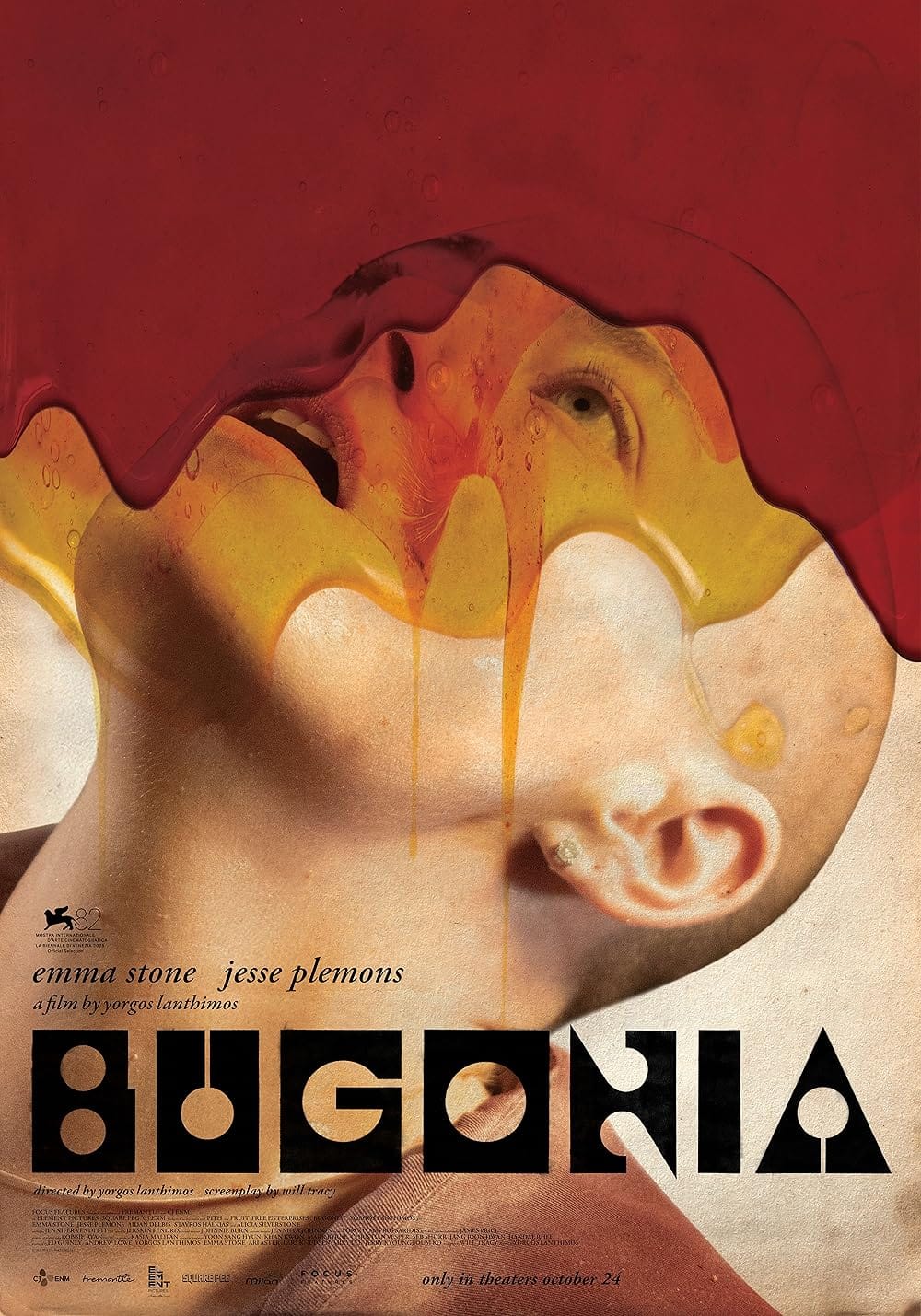
Two conspiracy theorists kidnap the CEO of a pharmaceutical conglomerate, believing that she is an alien who is planning to destroy Earth.
Bugonia is the English-language adaptation/remake of the 2003 South Korean film Save the Green Planet! by Jang Joon-hwan. I have yet to see Save the Green Planet! but a lot of people seem to consider it to be the one of the more important Korean movies of the century apparently, so I suppose I should probably make an effort to see it.
And after seeing Bugonia, I am definitely interested.
Jang Joon-hwan was supposed to direct Bugonia too, but they stepped out of the director’s chair, citing health concerns, but remained on as an executive producer. This led to the multiple Oscar-nominated Director, Yorgos Lanthimos, being hired as director. This is what drew me to Bugonia. A talented and innovative filmmaker with an incredible eye and an absurdist style, Lanthimos makes dark comedies that feature violent and often sexually explicit content, usually in eccentric settings, and often with heavy sociopolitical themes. And much like any filmmaker who has such a recognizable styles, on occasion, he can get a little lost in it. But while Kinds of Kindness (2024) was a bit of a misfire, between The Lobster (2015), The Killing of a Sacred Deer (2017), The Favourite (2018), and Poor Things (2023), I’m definitely a fan.
Lanthimos co-writes most of his films, with The Favourite and Poor Things being notable exceptions. Bugonia is the same. The adaptation was written by Will Tracy, who co-wrote The Menu, a film with great ideas and great dialogue, but one that didn’t quite connect at the end.
But while Bugonia definitely stumbles in some ways typical to both Lanthimos and Tracy, the pair’s strengths definitely outweighs their failings here.
So...
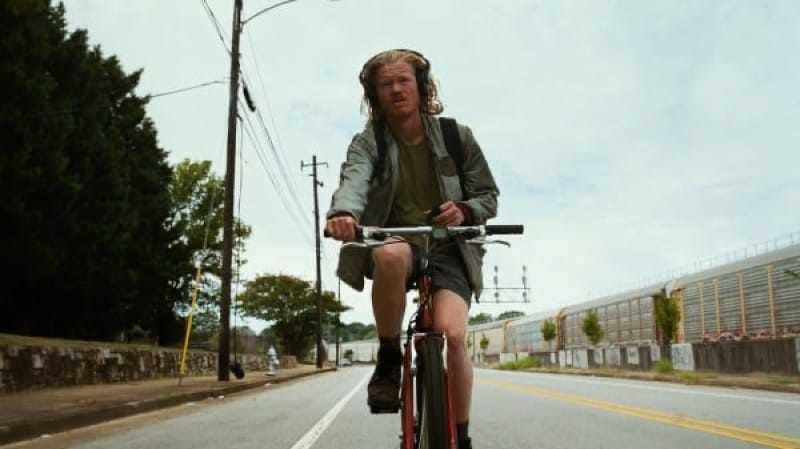
Teddy Gatz and his autistic cousin Don live on their family farm. They keep bees and spend their days training their minds and bodies, deeply immersed in the world of online conspiracy theories, and eventually chemically castrating each other in order to clear their minds and focus on stopping a coming alien invasion.
Michelle Fuller is the CEO of the pharmaceutical conglomerate Auxolith. After a few high-profile public corporate stumbles, Michelle is struggling to maintain the appearance of being a good boss who encourages her employees to have a healthy work/life balance, all while driving them relentlessly to produce.
Teddy blames Michelle for the fact that his mother is lying in a coma in the hospital after she participated in an Auxolith clinical drug trial. He believes that Michelle is responsible because she is secretly a member of an alien species known as the Andromedans. He believes that the Andromedans are not only responsible for poisoning humanity, like they did to his mother, but for causing the dying-off of Earth's honeybees, for destroying the world’s climate, and for generally dulling the minds of humanity, forcing everyone into a vacant-eyed, cow-like slavery.
Determined to save humanity, Teddy and Don kidnap Michelle.
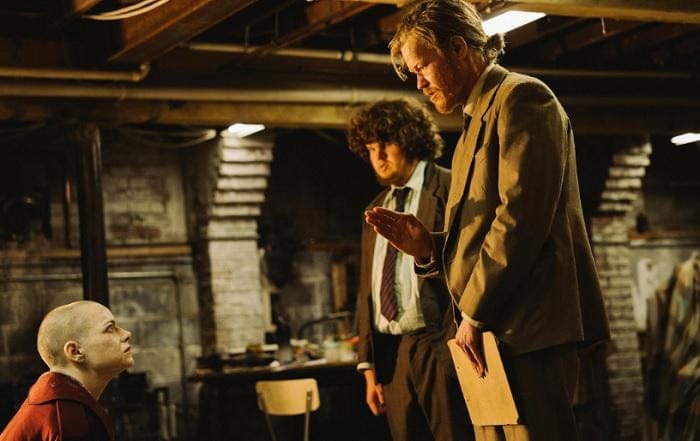
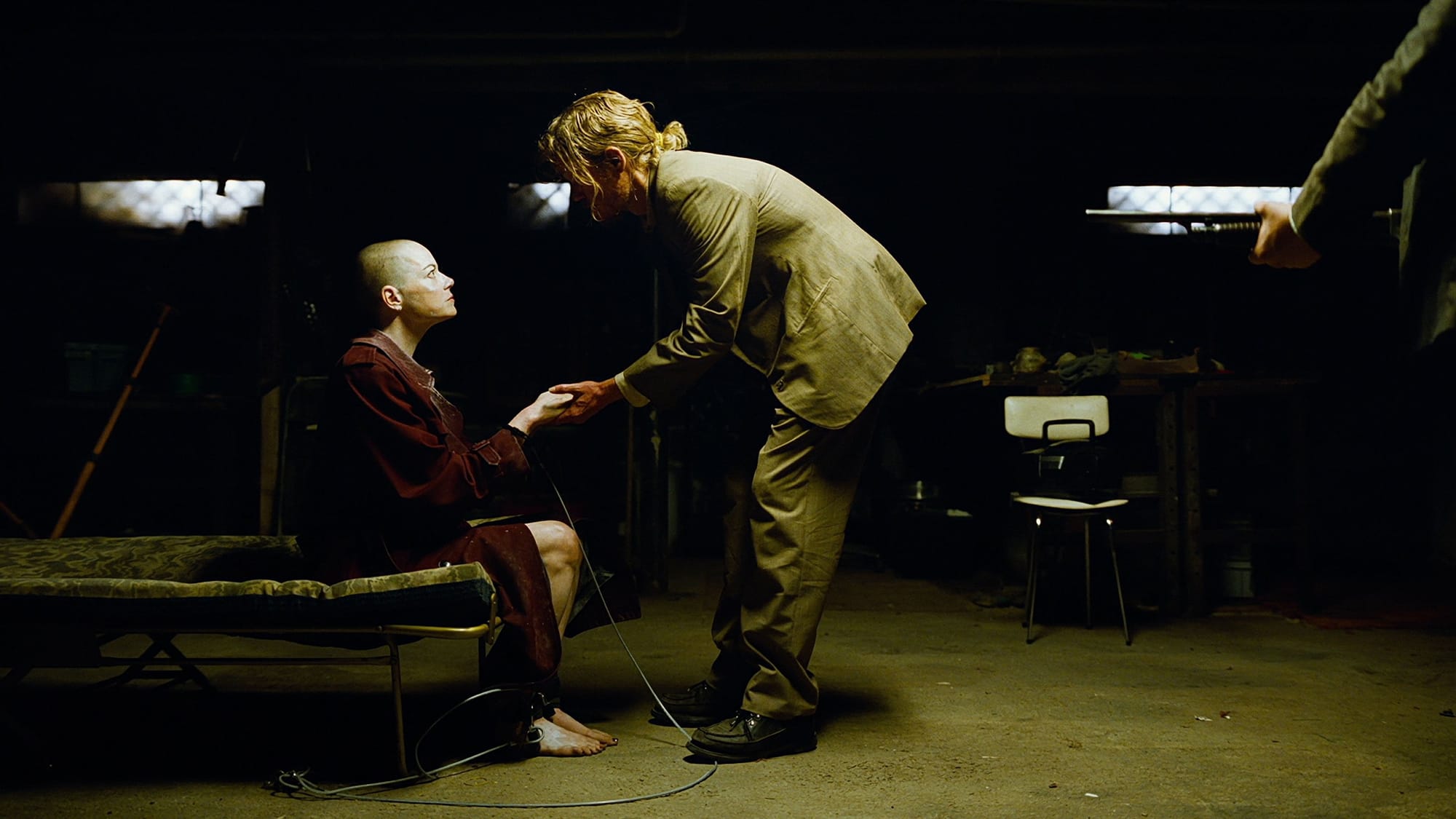
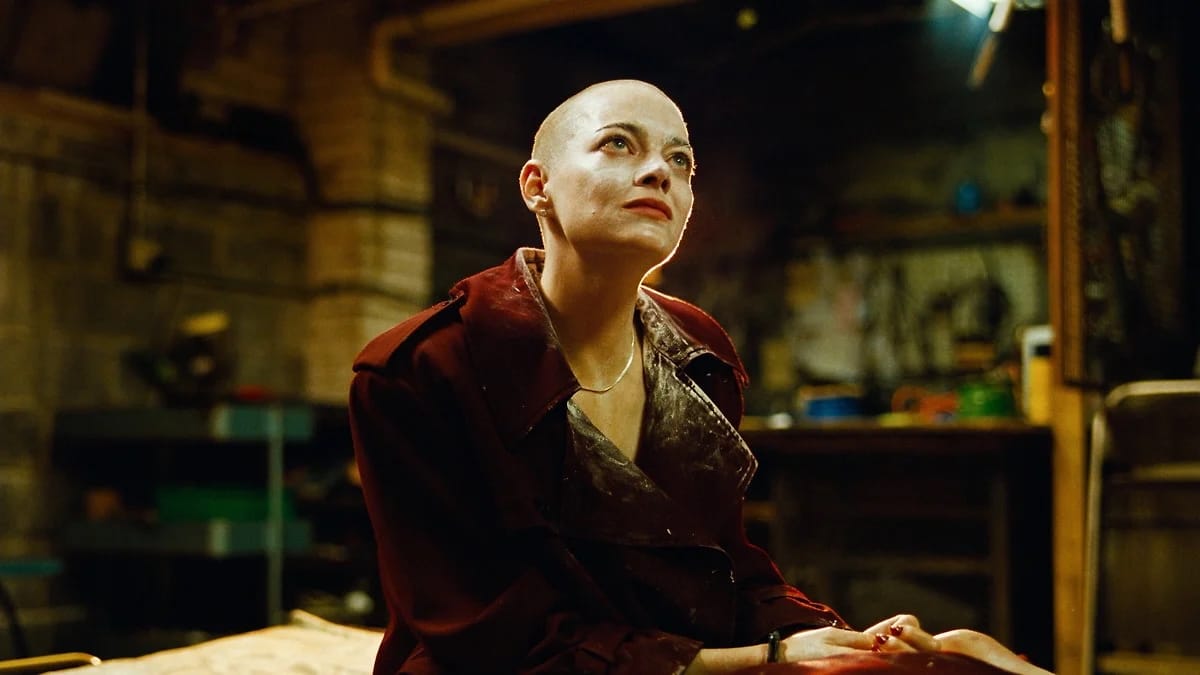
They imprison her in their basement. They shave her head, and slather her in antihistamine cream, all in order to prevent her from sending a distress signal to the other Andromedans. Teddy explains to Michelle that the lunar eclipse is in four days time, which will allow the Andromedan mothership to be able to enter Earth’s atmosphere undetected. Four days is how long she has to set up a meeting with the Andromedan emperor, so that Teddy can then broker a peace between the two species, freeing humanity from the yoke of Andromedan tyranny.
What follows is a ridiculous game of brinksmanship, of corporate CEO talk versus conspiracy theorist ranting, in a world where all the conspiracies are true… a world where aliens killed the dinosaurs, where Atlantis destroyed themselves through the dangers of unchecked science, a world secretly under extraterrestrial control, a flat Earth kind of world, a world being ruined by angry dupes, people broken inside by their hatreds and their idiot conspiracy theories.
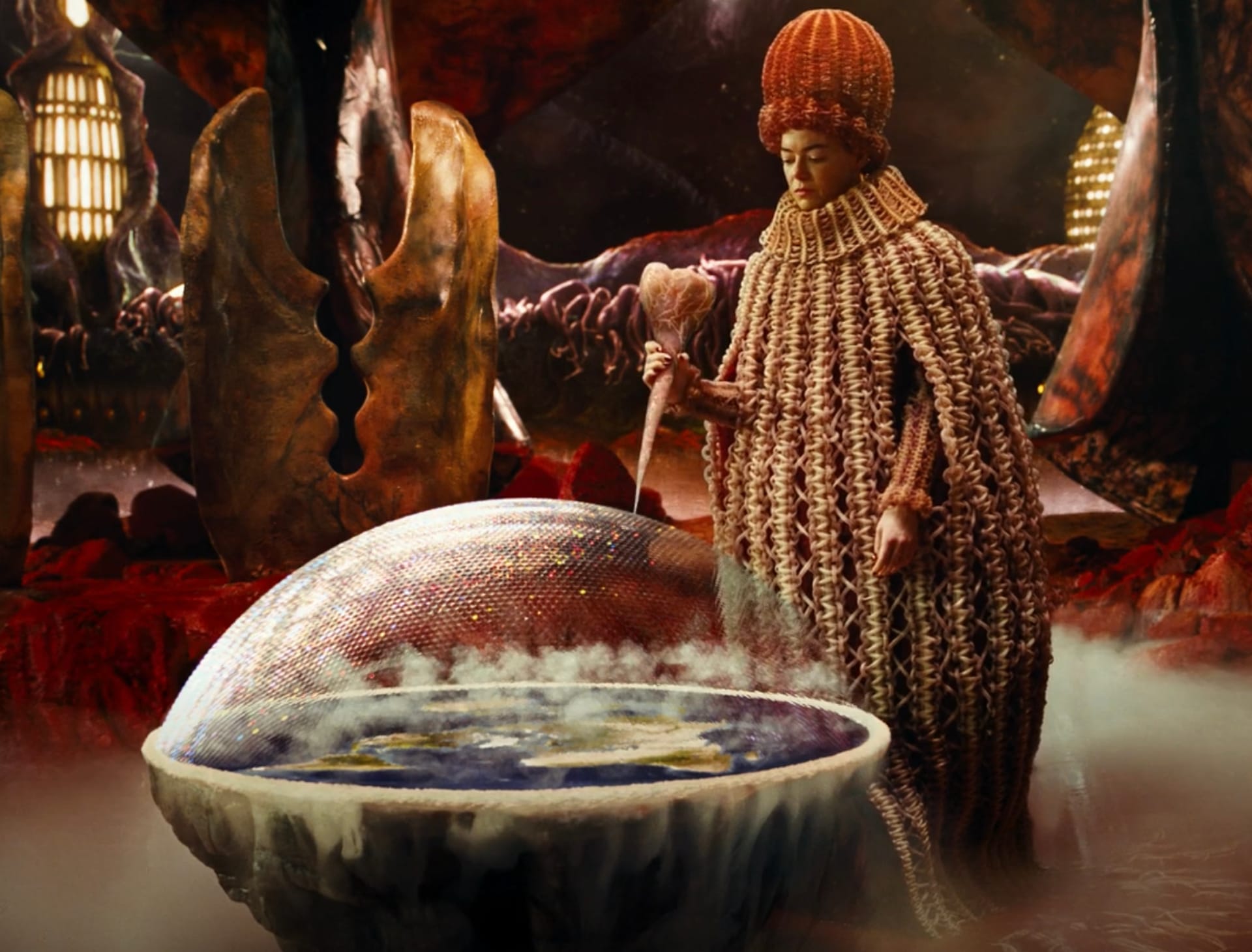
And while it's definitely a dark comedy, Bugonia is a very angry picture. It's mad at people. It's mad at the world. It's especially mad at all the harms being done to it, all the self-inflicted ills…
One can relate…
Bugonia is maybe Lanthimos’s most accessible movie. Yes, it has sudden tonal shifts, touching on uncomfortably taboo subjects, and even more sudden moments of violence, but as far as straight-forward narratives goes, Bugonia often feels kind of like a twisted version of the classic Amblin films of the 80s. Maybe it's all the bicycling through green small town/suburban America, but at the same time, it does have a similar kind of weird and funny and relatable world feel, but presented as if its nostalgia-powered charm had curdled, like its family-friendly fantasy-adventure has buckled under the weight of the awful reality we actually live in. Plus, while, yes, it’s definitely weird, it's not really all that weird, especially when compared to most of Lanthimos's work. It's pretty grounded, really, for the most part. Also, it’s definitely funny, but it's not outrageously funny, not in that droll kind barbed high art witticism kind of way at least. Like I said, it's an angry film, and sad too. Doomed, maybe that's a better description of the feeling. Like the world it takes place in is out of gas and starting to run down.
Again, one can relate…
The story is fun too. It draws you along. It keeps you guessing. Is Teddy just a crackpot lunatic? Or is Teddy a crackpot lunatic who is also right? Is Michelle just your basic run-of-the-mill evil corporate CEO who honestly deserves whatever weird just desserts Teddy has in store for her? Or is she actually an alien who is being held by angry idiots who desperately want to blame their (and the world’s) problems on anyone or anything except humanity’s relentless determination of self-destruction? It’s a film that feels like, at any moment, it could go either way, even multiple ways, so that's fun. Fun and weird and tense.
All in all, it’s an engrossing film, and a gorgeous film, powered by amazing performances. Emma Stone and Jesse Plemons are incredible, of course. Alone, they’re always scene-stealers, but together? Against each other? It’s fantastic stuff. Then there’s Aidan Delbis, an actor with autism who plays Don, a character with autism, and he is magnetic, providing an innocence, and also a surprisingly clear-eyed understanding, of the film’s events.
Good stuff.
And while the film does get somewhat muddled, at least, when it comes to the metaphor, and as far as who represents what, and whether the blame lies with one or both parties, and blah blah blah, and all that stuff, in the end it’s pretty clear… humanity is the problem.
We are the problem.
People who are afraid of this truth about society, something we are being shown daily, mayfind themselves a little uncomfortable at the film’s message. They may leave this film feeling a little angry. But for the most part, I think that’s probably more due to them refusing to consider the idea that they‘re only angry because hit dogs tend to holler, that they’re only really feeling stung by their own unaddressed complicity, that they have only been wounded by the keen edge of their own guilt, because somewhere inside, they know that they have sat by in the presence of evil, that they said nothing when faced with injustice, that they turned away when they were faced with bigotry. "Why should I take the blame for the evil that wasn’t done directly by me," they might ask. "All I have done is regularly break bread with those who do. Why should I be made to feel responsible?"
The answer, of course, is wrapped up in why the film is called Bugonia.
Derived from a Greek term that basically means "ox-born" bugonia refers to an ancient Greek/Roman belief that bees can be born from the decaying carcass of a sacrificed bull. It’s a myth of life born from death. Teddy and Don are apiarist, bees come up quite a bit in the film, and their presence bookends the film. This, along with the events of the rest of the film could all be wrapped up into a metaphor for the state of human civilization, and the idea that at least some new life can arise from the ashes of a corrupt world.
So sure, given the ending, the film could be read as having a somewhat bleak outlook on humanity, that we, as a species, basically “have it coming,” right? That our sacrifice so that the rest of the planet could go on and thrive would be a good thing. It's fair to say that this is a bit… extreme.
But at the same time, I don’t know if that’s quite what the film is saying. After all, the whole ancient idea of a Bugonia is fake, right? Bees can’t be born of dead bulls. As the old lady in that one commercial says, “That’s not how this works. That’s not how any of this works.” And in the film, the question of whether or not Michelle is actually an alien is a silly one, and for the same reason that conspiracy theories are generally silly. That Teddy sincerely believes he can save the bees, stop the climate crisis, and save humanity, all by negotiating peace with an intergalactic empire is a nonsense idea, but he believes it because his world is out of control, and the reality of the problems the world is facing much more difficult, much more complex, and much harder and much more daunting to deal with. So there’s a safety in magical thinking like that, in the "simple" solution, something we often see people get lost in when they're faced with the myriad of problems we have today. And the result is always the same... getting lost in those kinds of ideas is only harmful and a stupid waste of time, because these ”simple” solutions aren't going to happen, as much as we may wish otherwise. I don't think Bugonia is trying to say that we’re doomed. I think the film is saying that when we waste time with that idiot nonsense, whether its indulging ourselves with conspiracy theories, or embracing any of the nonsense anti-science lifestyles out there, basically when we blindly deny the reality of the world, and refuse to confront the rampant evil humanity we are all causing every day, the rampant evil that is happening within our own social circles, because if we were to do anyting else it would be inconvenient and uncomfortable... we risk dooming ourselves. I think Bugonia is saying that the act of bugonia, those silly beliefs, immersing onself in that magical thinking, that itself is the trap.
I think that the film is also saying that its better to face the hard problems head on, because ultimately, regardless of what results, once we face that reality, and do the hard thing, and actually take out the trash… it's a brand new day.
And life will go on.