Hamnet
The play's the thing...

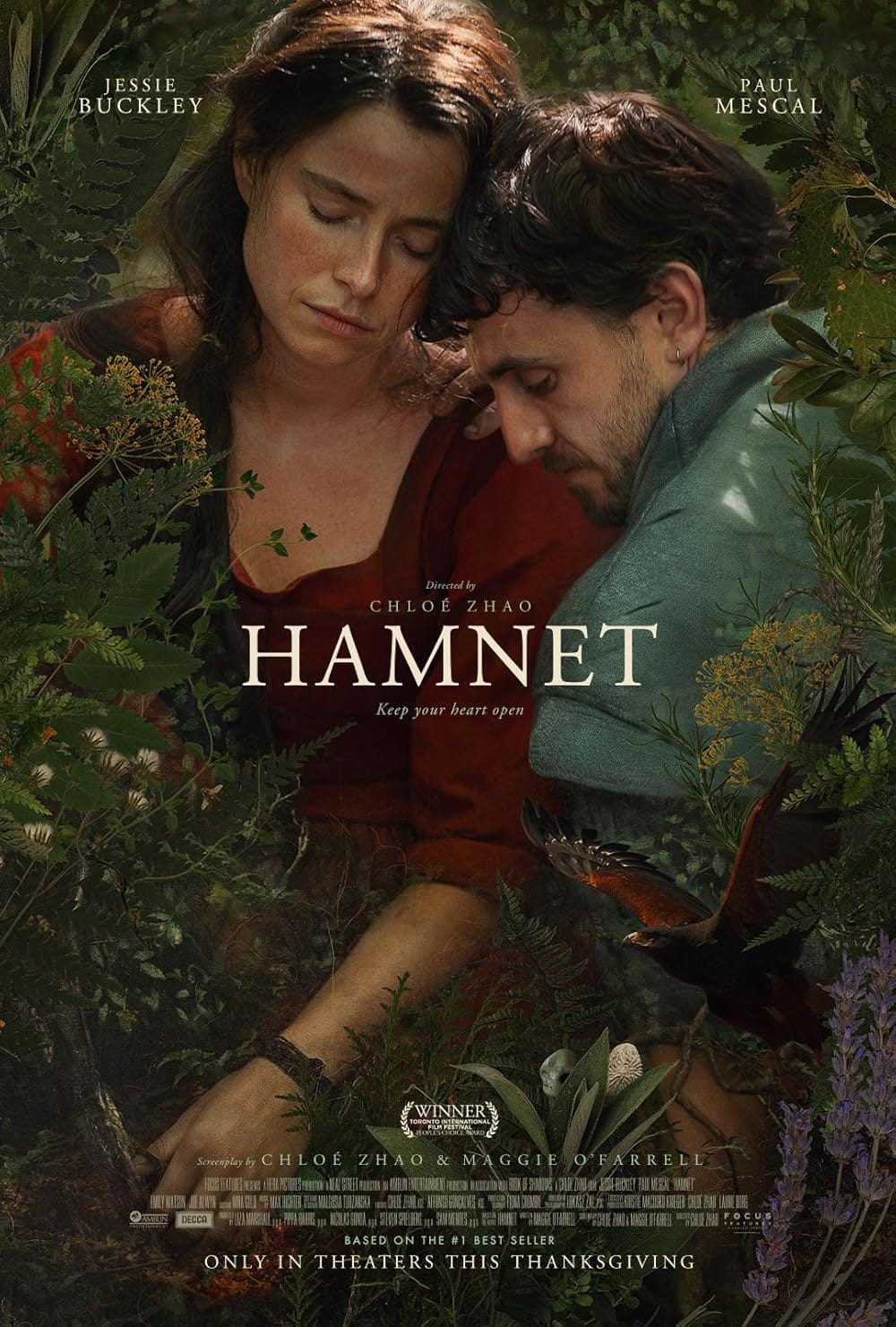
After losing their son Hamnet to plague, Agnes and William Shakespeare grapple with their grief in 16th-century England.
I love Chloe Zhao’s stuff.
One of the more exciting directors working today, Chloe Zhao is great. She's inventive, empathetic, has a great perspective, and an even better eye. Her films are absolutely beautiful: Songs My Brother Taught Me, The Rider, Nomadland, The Eternals... all fantastic films. Honestly, if you haven't seen The Rider, than you're wrong, you're just wrong.
She's very talented.
Even more exciting? Next up, she's making the new version of the Buffy the Vampire Slayer tv show. I am especially intrigued by this, as I'm a big fan. But therein lies the problem. On one hand, I don't know what Buffy will be without Whedon at the wheel, but also, I'm really glad that creepy fucker isn't going to be involved. So while I don't know what to expect, Zhao's involvement gives me some hope, but with little else known about the show or what it's going to look like, at the moment, all I can say is that I'm very interested to see what it turns out to be.
But that's a post for another day.
My point is, when it comes to her projects, Chloe Zhao makes some eclectic choices, and now, here we are with Hamnet... A fictionalized narrative about the marriage of Agnes Hathaway and William Shakespeare. It specifically focuses on the tragic death of their eleven-year-old son, Hamnet, and how that loss and grief strains their relationship, but ultimately inspires the play Hamlet.
So... a little bit different from her last movie.
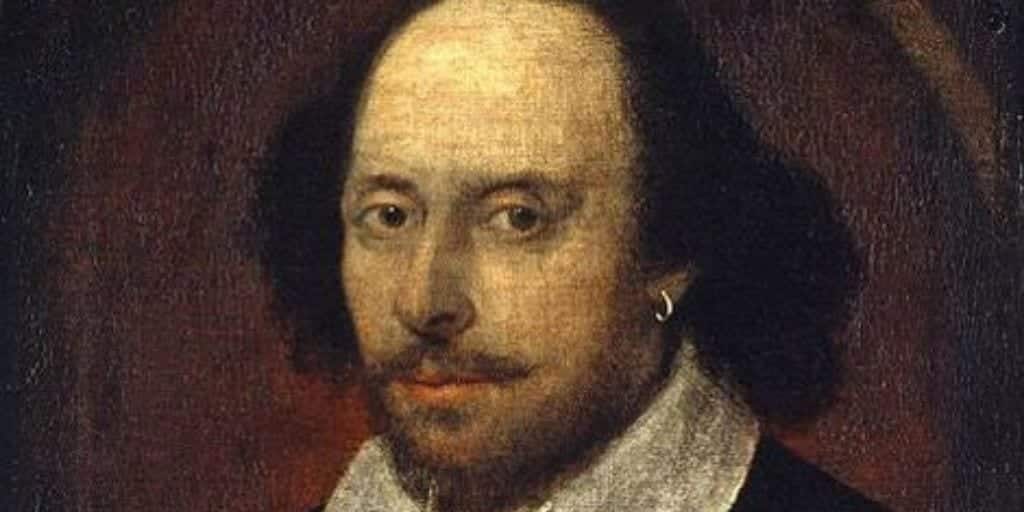
Everyone knows William Shakespeare.
Born in 1564. Died in 1616. He was an English playwright, a poet, and an actor, widely regarded as one of the most influential writers in the English language and the world's pre-eminent dramatist. Often known as "the Bard" he wrote almost 40 plays and close to 200 poems in his life, most of which have been translated into every major living language, and his plays are performed more often than those of any other playwright.
He's kind of a big deal.
Born and raised in Stratford-upon-Avon, Warwickshire, in England, he married Anne (sometimes Agnes) Hathaway at 18, and had three children: Susanna and the twins Hamnet and Judith. Sometime in his twenties, he started working in London as an actor and writer with an actor's troupe, called the Lord Chamberlain's Men, out of the Globe Theatre. He retired at age 49, right around the time the original theatre burned down... which was probably a coincidence, I assume... and then he moved back to Stratford and died a few years later.
And that's basically all that can really be said for certain about the life of William Shakespeare. Little else detailing his 52 years on Earth exist. As a result, there's a considerable amount of speculation about who he was, what he looked like, who he loved, what he believed in, even whether or not he actually wrote all of the words attributed to him. It's fair to say that a lot of hay has been made of those gaps.
“And as imagination bodies forth
The forms of things unknown, the poet’s pen
Turns them to shapes and gives to airy nothing
A local habitation and a name”
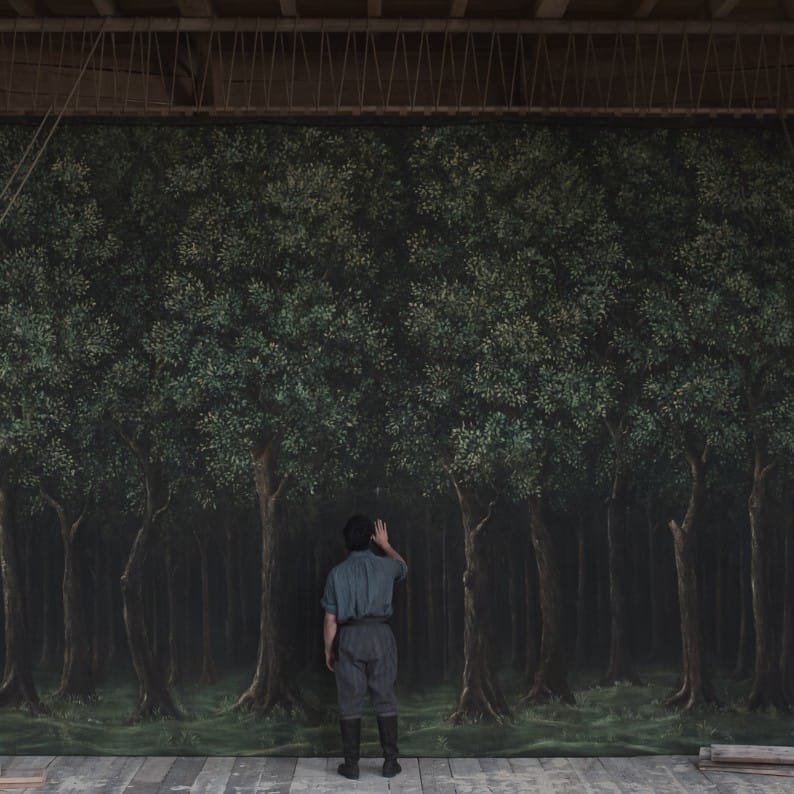
The Tragedy of Hamlet, Prince of Denmark, was written by William Shakespeare sometime in the late 1500s and early 1600s. It's his longest play. Set in Denmark, it's about Prince Hamlet and his attempts to exact revenge on his uncle, Claudius, who has murdered Hamlet's father, and taken Hamlet's mother as his own, all in order to seize the throne. It is considered to be one of the greatest plays of all time, and like so many of Shakespeare's works, has a seemingly endless list of retellings and adaptations–like the tv show Sons of Anarchy, for instance.
The origins of the story itself are a bit more murky.
Similar legends can be found all over the world, from across Europe and Scandinavia, in Imperial Rome, over to Constantinople and the Arabian penisula, including the "Life of Amleth" heralding from 13th century Denmark–which was the basis for the film The Northman–and was translated into French only a few years after Shakespeare's birth. This is the long way of saying that, the origins of Hamlet probably didn't whlly begin with the death of Shakespeare's son, Hamnet, who died a few years before the time that is commonly considered to be when the play first appeared, at least not solely, and that this story is all nothing more than myth and legend, the result of the fog of time and our need for the more easily understood and more romantic of motivations. Maybe.
Or maybe it's all true.
"No legacy is so rich as honesty"
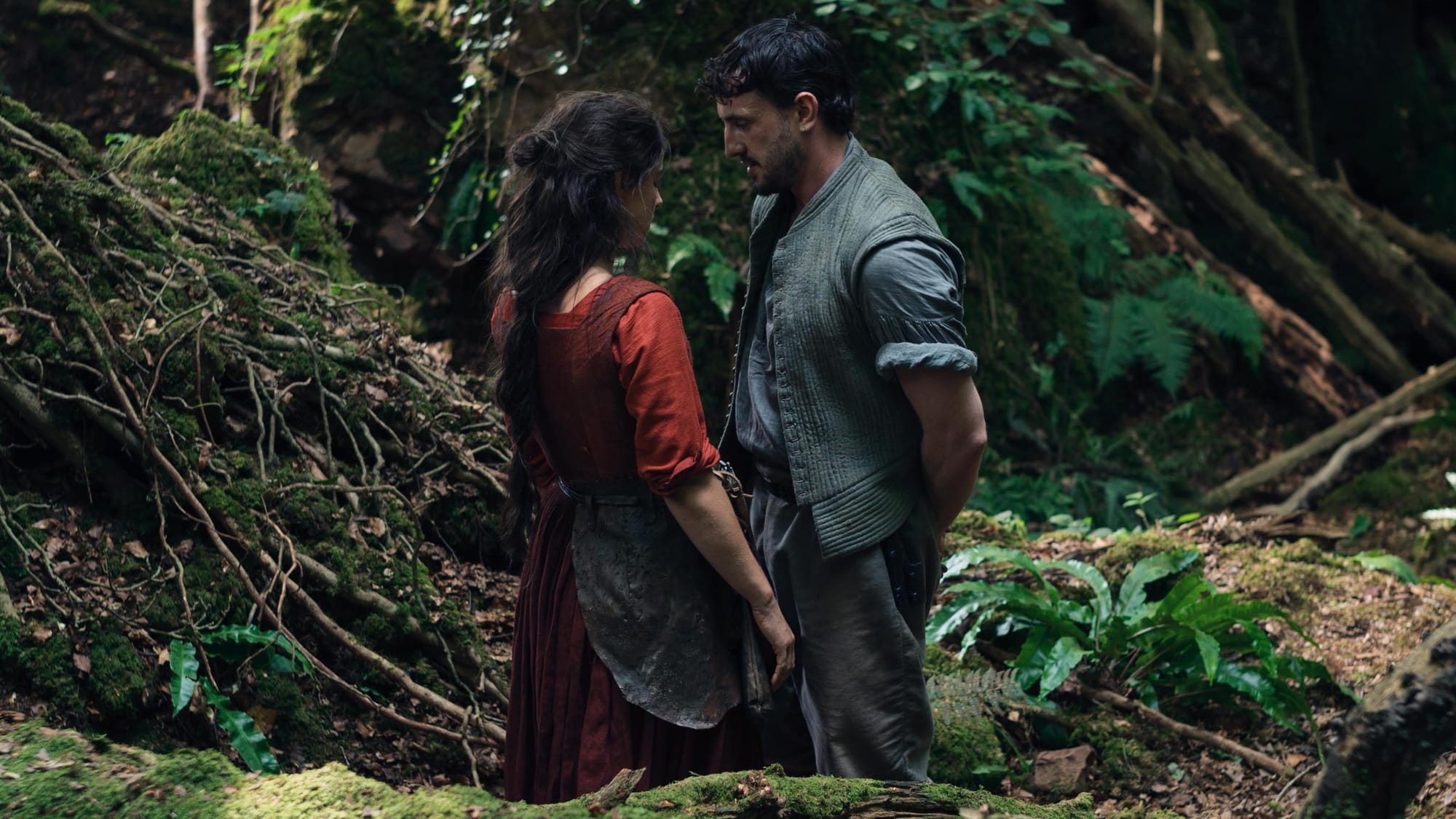
“Hamnet and Hamlet are in fact the same name, interchangeable in Stratford records in the late sixteenth and early seventeenth centuries.” – The death of Hamnet and the making of Hamlet
Agnes Hathaway awakens from a nap in the quiet greenery of the forest, curled up near the mouth of a mysterious cave. She is a hedge witch, a falconer, and a wild thing of the woods. She gathers herbs and listens to the wind in the trees.
A scholar, a scribe, and an aspiring young playwright, William Shakespeare is working in her family home as a tutor in order to help pay off his family's debts to the Hathaways. But when he sees Agnes returning from the woods, he leaves his students, and finds her in the barn.
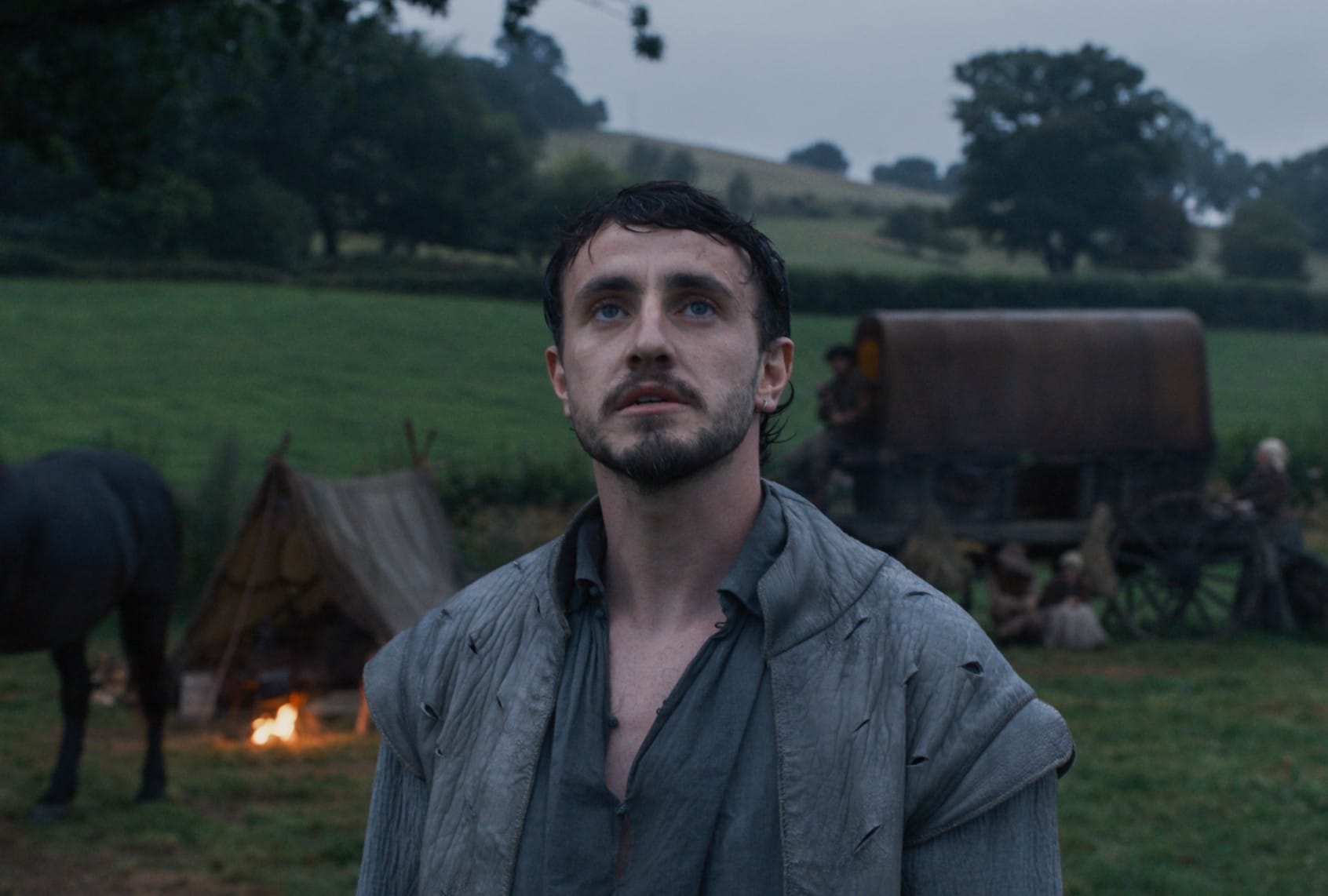
They make out almost immediately.
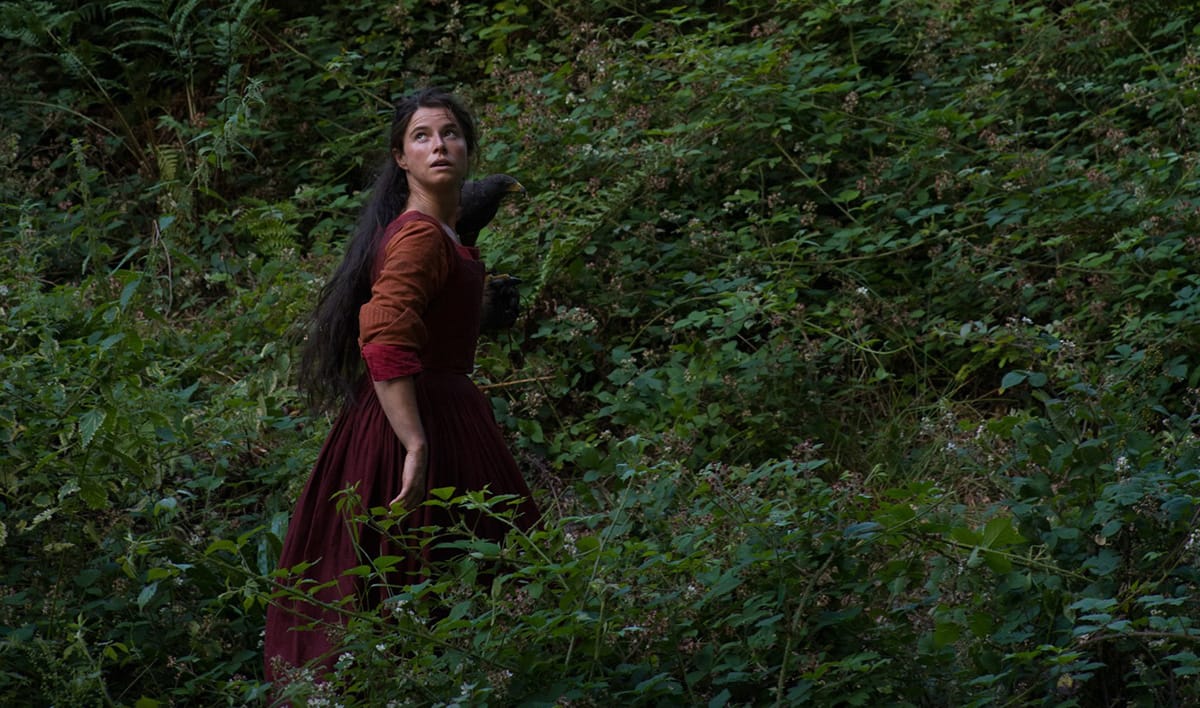
William's mother, Mary, informs him of the local rumours that Agnes is the daughter of a forest witch who taught her herbal lore. This turns out to be true, as Agnes later uses the Nine Herbs Charm as she grinds and mixes a poultice to heal a small cut on William's forehead.
Remember, mugwort, what you brought to pass, what you readied at Regenmeld. You’re called Una, the most ancient plant. You defy three, you defy 30, you defy venom, you defy air illness, you defy the horror that stalks the land. And you, waybread, plant mother, you’re open to the east yet mighty within. Carts creeped over you, women rode over you. You withstood it all, and you pushed back...
William tells her the story of Orpheus and Eurydice, delighting her. Agnes reads William's palm, foretelling a successful future for him, and that their two children will stand at her deathbed. They do it in the barn, and Agnes is soon pregnant. Her family disowns her, forcing her to move in with the Shakespeares, and the pair are soon married. A few months later, Agnes wanders out into the woods, squatting and screaming and shitting out little Susanna on the ground.
As the years pass, life in their small town begins to wear William down, affecting his writing. Seeing this, Agnes gets her brother Bartholomew to finance William moving to London for a theatrical career, leaving her and Susanna behind with William's family in Stratford, and with her pregnant again.
When it's time, Agnes tries to go out into the woods to give birth, but the rains are falling heavily, and the river is flooding. William's family makes her stay home and she basically gives birth in the family room, on the dining table, and all while flood waters are creeping in under the door, so you know that house smelled awful for a long time after. Agnes finally gives birth to Hamnet, and soon after, Judith, who at first seems to be stillborn. The midwife attempts to take the dead baby away, as it was thought to be bad luck for a mother to look upon a stillborn baby, but–driven by the memory of how she was kept from her own mother's deathbed as a child–Agnes defies custom and superstition, and clutches the baby to her.
Judith awakens.
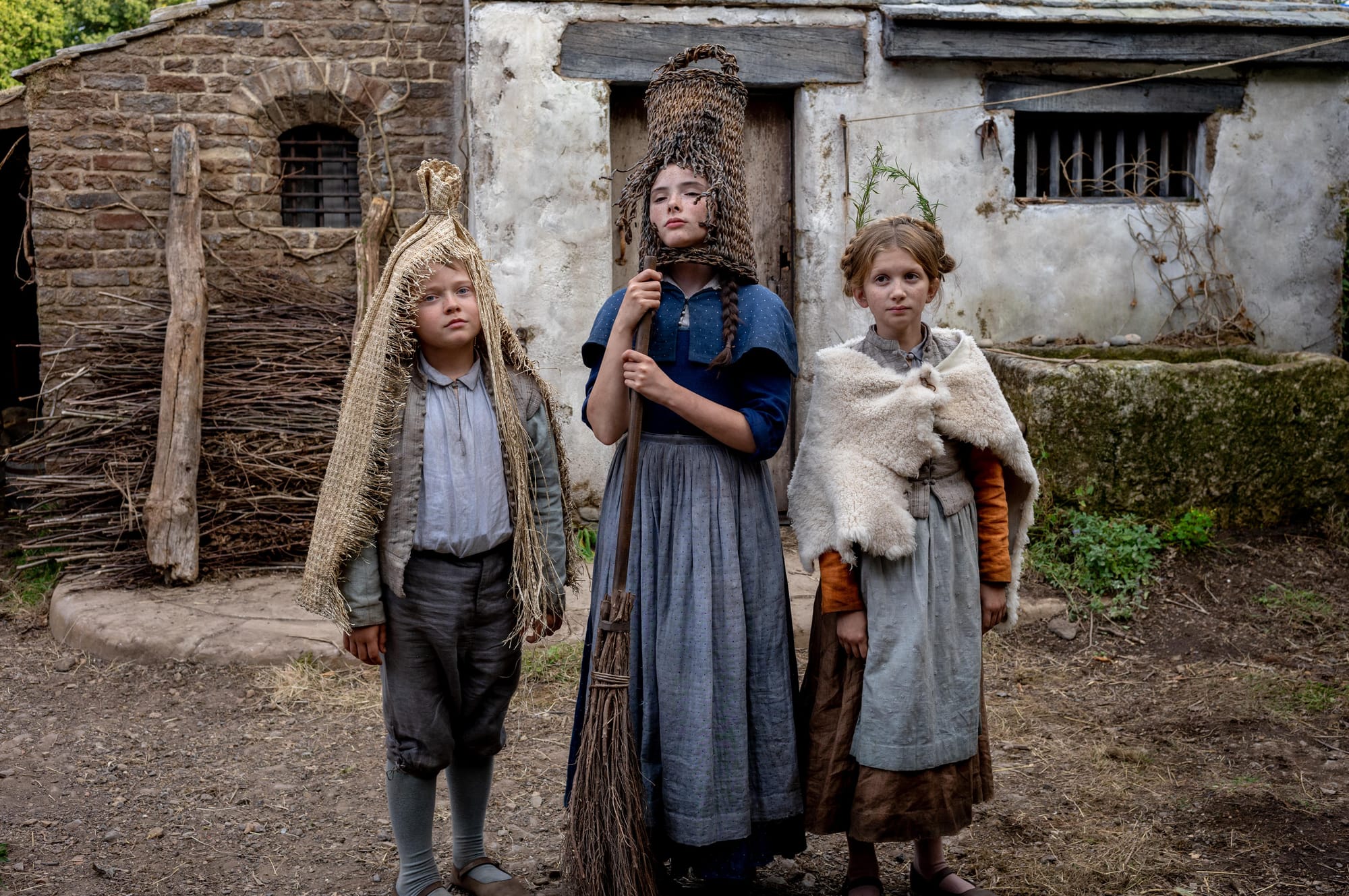
11 years later...
Now successful, William returns only occasionally, while Agnes and the children grow up very close, putting on plays and playing tricks. When he is home, they are happy. Agnes foretells that Hamnet, who wishes to one day join his father's theatre company, will some day flourish on stage. When Agnes's hawk dies, the family buries it, and they show the children how to whistle and encourage them to make a wish to the hawk's spirit, who she says will carry them in its heart.
In London, William wanders the streets during an outbreak of the bubonic plague, seeing the bodies carried away by the plague doctors and a puppet show about the pall of death amongst them.
In Stratford, Judith contracts the plague.
Hamnet, seeking to save his his sister by tricking death, confusing it because they are twins, believing that death won't be able to tell them apart, lays next to her in bed. But while Judith miraculously recovers, Hamnet falls ill and soon dies. On his deathbed, he envisions himself on a stage calling for his mother, and Agnes's hawk appears. William rushes home, but doesn't arrive in time. His absence during all of this strains he and Agnes' marriage. When he must depart for London again, Agnes angrily rebukes him.
For a time, they both wallow in their grief, struggling to go on.
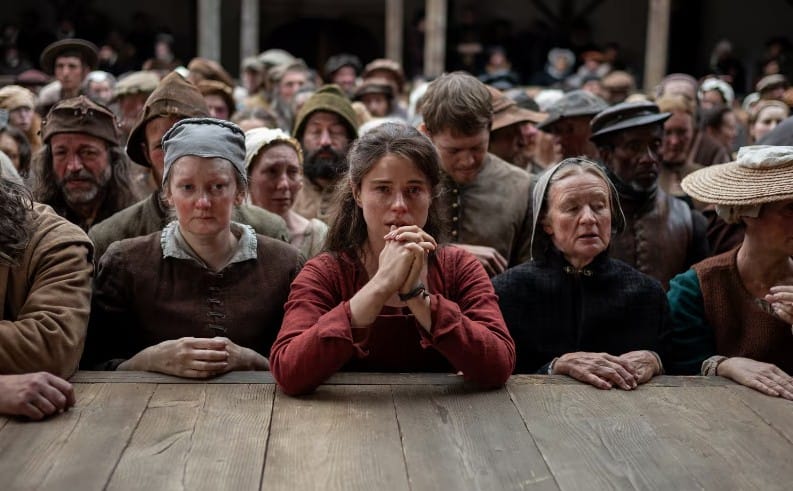
Sometime later, Agnes is shown a playbill for William's latest play. She is shocked to see that the title of the play is Hamlet. Angry, confused, Agnes has Bartholomew take her to London to see William, but unable to locate him, they end up attending the first performance of Hamlet at the Globe Theatre. Initially offended, thinking her son is being profaned, she is moved to tears by the scene between Hamlet and the ghost of his father, who is played by William.
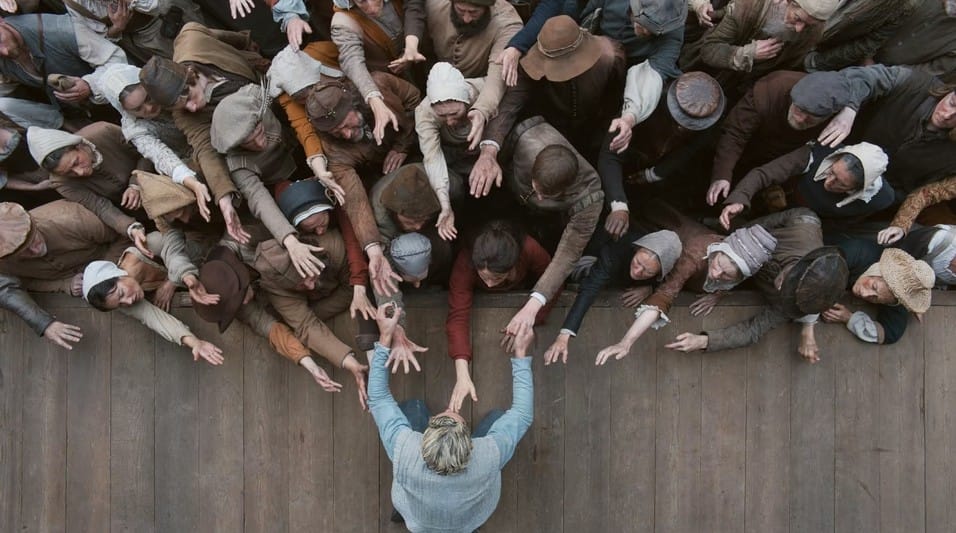
William watches from the wing, crying and watching Agnes. The play progresses through scenes of sword-fighting, fulfilling Hamnet's dream of such a role. During Hamlet's death scene, Agnes reaches forward for the actor's hand as she had held William's when they first met, and the rest of the audience reaches toward him too. And it's then that Agness realizes that the crowd mourns her son's memory, even if they do not realize it themselves. Healed, transported in that moment, Agnes sees Hamnet on the stage, just as she had seen him in her vision, and he smiles before he slips backstage through a hole that resembles the forest cave, and disappears.
For the first time since Hamnet's death, Agnes laughs and smiles.
Chloe Zhao often uses wide open spaces in her films, exploring the freedom those spaces represent, the lonliness, the search of self-discovery, and it‘s clear from the start that this aspect is missing from this film. In Hamnet, everything is much more closed and restricted. There’s a lot of low ceilings and close walls, and for a good portion of the film, the family lives beneath the slanted eaves of the attic.
It’s all very tight and oppressive.
This is meant to highlight the stress of having to provide for those depending on you, the pressure to create, the restraint of society, especially when contrasted with the freedom of the forest. It's also used to illustrate their grief, especially following Hamnet's death, as those small space are often shown empty, in order to amplify that feeling of loss.
It's kind of a basic and obvious visual language, I know, but I really do appreciate when it's done so well, and it's done really well here.
Another thing that the film does really well is create that sense of mysticism and the very visceral power of nature. Train Dreams tried for a very similar feel/idea, but in comparison, the fact that it truly was mostly just vibes and Terrence Malick homages is undeniable. Although, to be fair, Joel Edgerton did not bring anything close to the ferocious energy that Jesse Buckley does as Agnes. She is incredible, a absolute revelation in this role. You can't stop watching her. I have seen more than a few folks out there already calling her the greatest actress of her generation, and while I feel like maybe that's a bit premature, god damn... maybe it's not, y'know? I will be definitely be watching for more of her in the future.
That said, the film doesn't quite all work.
Maybe it's a little too long. Maybe it's a little too obvious in its intent at times.
This is, after all, a story about how the pieces of William Shakespeare's life ended up influencing his work, specifically the death of his son Hamnet, but that's not the only piece this movie shows. Even the most passing of familiarities to the Bard's oeuvre will recognize the myriad of nods in this film. Does that mean that the traditional terrible trappings of the typical music biopic appear here? The shit that Walk Hard parodied so well? Does that mean that could imagine hearing Jenna Fischer parodying Reese Witherspoon's Tennessee drawl as she shouts in his face, "Don't you dare write a play right now, Shakespeare!" Maybe a little bit, sure, but overall, it's not quite that bad. Nor is it a more dramatic version of Shakespeare in Love either (Remember that dog crap? Seven Academy Awards! SEVEN! Good Lord!), where the entirety of the various goings-on are all obvious knowing winks to those stories we know so well.
But also... yeah, it's a little bit like that.
Plus, when Agnes and Shakespeare first meet, they have an interaction that, while it is obviously a distant echo of Romeo and Juliet's first meeting, at the same time, it's so fast and so much like... "What's your name?" "Agness. What's yours?" "Will. Wanna kiss?" "Totally." And then they do, and for a moment you're like... Wait... do they already know each other? Is this like a sex game or something? It's not, so it's just kind of awkward. It's a little thing, and it passes quickly, but it's still more than a little awkward.
Also, another little thing, other than a glimpse of the Plague Doctors in their familiar nightmare-fuel masks, and Hamnet's death, obviously, there's little direct mention of the plague. Not even like a: "Have a good trip to London! Be careful down there, Will, because... y'know... the plague and all." It's not the focus of the film, obviously, but the absense was enough to make me wonder if this was just a reflection of attitudes today, that refusal of society–Americans especially–to even glance back for the briefest of moments, even from the side of our eye, at the literal mountain of dead that we allowed to pile up within the past decade, and through that silence and refusal of acknowledgment, allow to continue to pile up, and all for no other reason than a selfish disregard for others because, god damn it, we just had to go to fucking Chili's. We had to! And maybe this refusal is not just because of guilt either, there's shame too. After all, refusing to break with the herd and mask up, at least in grocery stores, on public transit, and in hospitals, is the height of unbridled selfishness, absolutely inexcusable when examined under even the dimmest of lights, but it's also a big part of why this country is in the dire straits that we are today. A person cannot decide to shut off their empathy in just one part of their lives selectively, and then continue to be an empathetic person in all other aspects. It's all or nothing. Allowing yourself to be fine with the endangering of others, all so that your life is more convenient and comfortable is a Pandora's Box. Once that fucker is opened, once you decide it's okay to condemn one group to die, whether it be the people who are most vunerable during an on-going pandemic, or transgirl middle schoolers playing girl's basketball, once you have decided that this one specific group is not worth you perhaps being uncomfortable for a moment, or maybe being minorly inconvenienced, or having to possibly make a few small adjustments to your life or your attitude, well then, suddenly it becomes that much easier for you find other people who might inconvenience you, or who make you uncomfortable, or who maybe you just don't like...
Either way, look around, the fact remains that, in general, American society has little time or patience for any "plague talk" and this is especially true for the movie theatre industry, as they blame their ever-declining attendance on the lingering effects of COVID... rather than admitting that it's actually due to tickets being too expensive, and that when this is coupled with the fact that the facilities are usually filthy–no one has ever mopped that theatre, asshat. EVER! Why are you taking off your shoes, you fucking gross pig?–not to mention that the presentations are often subpar too, and worst of all, the audiences almost always ruin every expereince, so that home-viewing is almost always a generally better experience, making going to the theatre no longer worth the cost, but I digress... was this Hollywood bowing to pressure from the theatre owners?
I don't know, but I noticed the absense.
Or maybe this is just Shakespeare actually being his most relatably human? After all, the real Shakespeare, despite living in a world that was regularly stalked by the beast of the bubonic plagu, he pretty much never addressed it directly in his work. Maybe, after the death of his son, and who knows how many others that he knew, due to the Plague, he just wanted to move on and not think about it anymore?
Who knows?
I did like how, much like in Sentimental Value, Hamnet is all about the healing power of art, the need to create, and how you need art to live. I like seeing multiple projects talking about that this year, especially as it's a year where we are beset on all sides by so many soulless, ugly motherfuckers, whether the white supremacist bigots of the GOP, especially the Christians in the small towns and suburbs, or the lazy mediocre fuckers pushing GenAI into everything, poisoning the world, ruining the economy, and stealing from artists, all to satisfy their tedious, insatiable need for acclaim and accolades that they could otherwise not obtain on their own. But while the final act is the big play, and very much an undeniable and breathtakingly powerful arguement for this theme, in Sentimental Value, it is presented in a much more understated and ultimately much more moving way. Here, it's a god damn sledgehammer to the forehead. I'm not saying this is bad, or that it's not effective, I'm just saying that it is NOT subtle.
Well, except for one part...
Young Hamnet is played excellently by Jacobi Jupe, and the casting of Noah Jupe (Jacobi's older brother) as the actor playing Hamlet in the play is an exceedingly clever and absolutely sublime touch. The reason for that small echo you feel for the child Hamnet, for that tiny pang of familiarity upon seeing the actor on stage is obvious, once you know that they're brothers in real life, but on screen, it's not so, and as a result, it feels like the end of a line of spirituality and magic that has been pulsing throughout this film, most especially through Agnes, through whose eyes we are witnessing the play. It's a big part of what makes the film's climax such an incredibly cathartic moment, triggering such an emotional release.
It's the kind of moment that you do love to experience with a crowded audience in a theatre, and its a shame that greed and mediocrity has made this much more rare of an experience, but it's that moment of collectively held breath, the attention of the crowd absolutely riveted on screen, the very air heavy, pulsing with pressure, like a dam holding back a flood of emotion, creaking and straining and just about to burst, and what makes it all the more amazing and all the powerful is... at the same time, that's exactly what is happening on screen.
Is it baldly manipulative? Sure. A little. Does the film fully support the emotional build-up to that moment? Maybe not, not fully, at least. But still, in that moment, it is undeniably masterful and fantastic work.
Pure cinema.
In the end, this is a film that brims with emotion. And the simple truth is, you can't have that much emotional heat without some sentimentality boiling over. And you have to just allow for that. But that said, I do think that Chloe Zhao makes it work. Mostly. Maybe it wasn't all quite earned, but I still loved it.