Materialists
Coke and Beer?

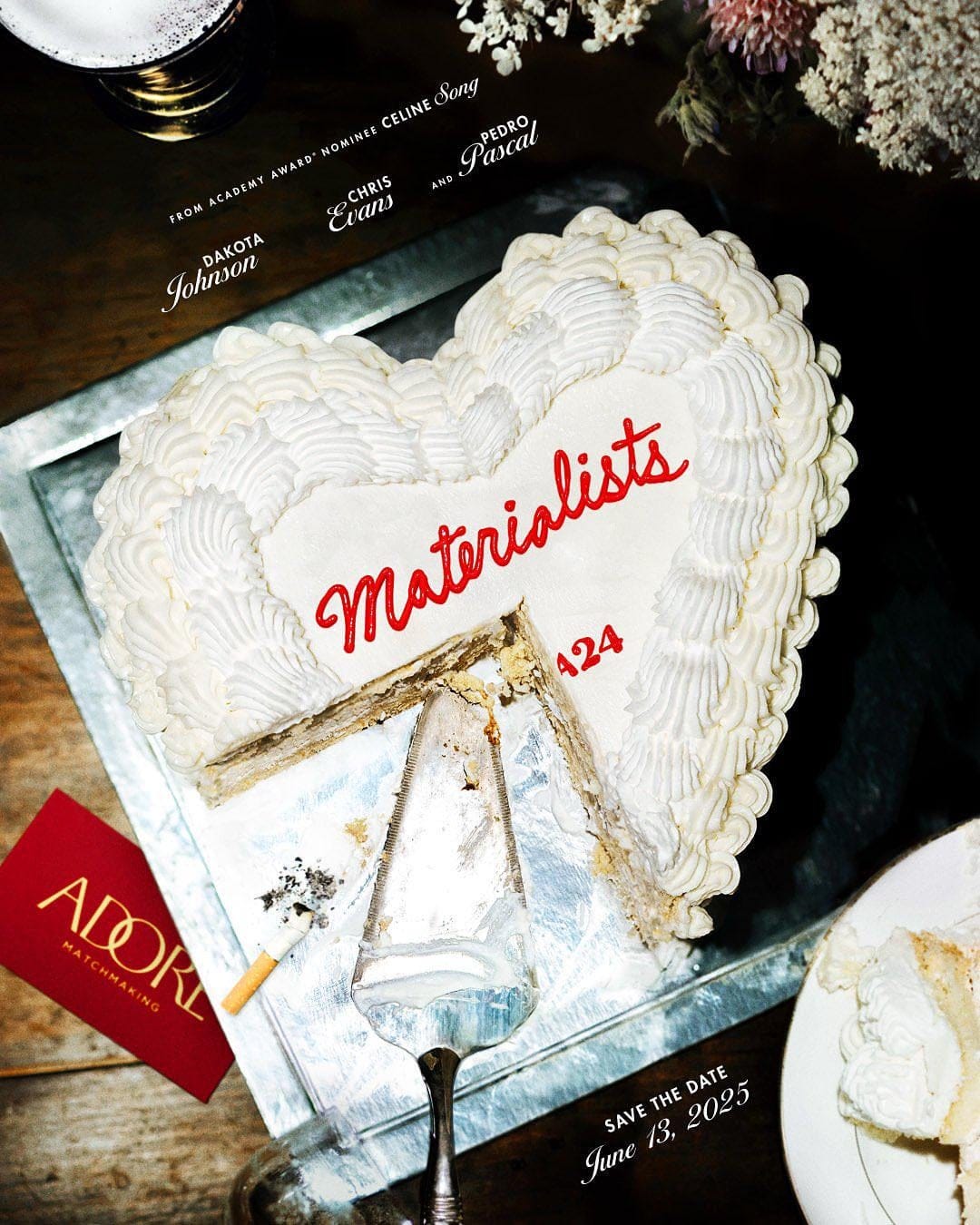
A young and ambitious New York City matchmaker finds herself torn between a man who is seemingly her perfect match and her imperfect ex-boyfriend.

Materialists was written and directed by Celine Song. This is her follow-up feature after her Oscar-nominated debut Past Lives.
I really loved Past Lives, so I was looking forward to this movie, the story of Captain America versus Mr. Fantastic for the heart of Madame Webb. In actuality, Materialists turned out to be a surprisingly pragmatic, almost anti-rom-com romantic comedy. This is a film centered on the age old question: To marry for love or money, as we watch a young woman deal with a love triangle between a man who checks all the boxes, but creates no sparks, and a man who is a bad bet on paper, but with whom she has an undeniable connection.
It's one of those movies that afterwards makes you wonder... who is this film for? Who is the intended audience?
So…
Failed actress Lucy Mason is a successful matchmaker at Adore, a matchmaking company in New York City, all of which feels like the kind of set-up that should be the basis of a CW show called “Heart of the City” or something like that.
Becoming increasingly frustrated by the shockingly ridiculous and unrealistic demands of the kind of wealthy loser dipshits who would use a service like hers, Lucy very obviously loves to calls herself an "eternal bachelorette," stating that she intends to either die alone or marry wealthy. This is typically the kind of thing any twenty-something baby will say after a disappointing Saturday night and a few brunch Bloody Marys, but in a Rom-Com it means only one thing...
Love is on the horizon.
And wouldn't you know it...
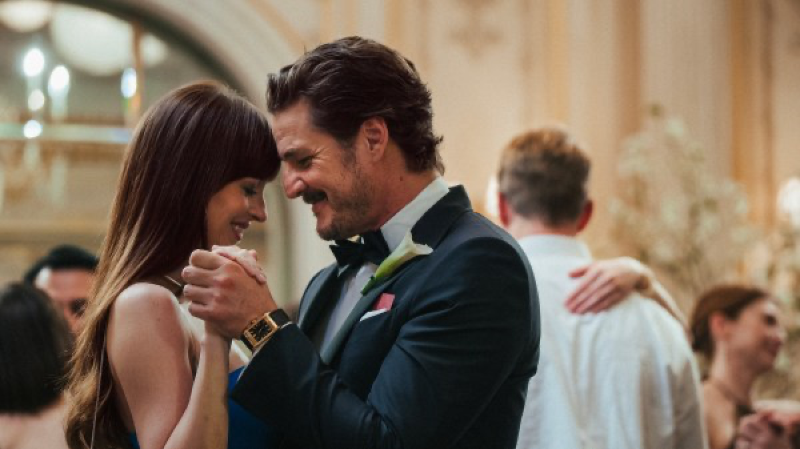
When Lucy attends a former client's wedding, the ninth one that she has been responsible for, at the reception, she meets the groom’s brother, the financier and uber-wealthy dreamboat, Harry Castillo.
He shows interest in her, but Lucy is an iceberg, so she rebuffs him, suggesting instead that he become an Adore client. She explains to Harry in a very matter-of-fact tone that he is what they call in the business a "unicorn" a too good to be true single guy who has money, manners, looks, and style, and for some reason, is still single. Despite this immediate red flag, Harry doesn't politely excuse himself and then go find someone else at the party who isn't an off-putting weirdo, but then... maybe that's why Harry needs a matchmaker.
Anyway, Lucy then runs into her ex-boyfriend John Pitts, who is working as a cater-waiter while he continues to pursue his obviously "not happening" dream of acting, a dream that Lucy gave up on, most likely at the same time that she gave up on John. John reveals to the world, and Harry, that Lucy likes drinking "coke and a beer" which... I mean, what the fuck, man? What the fuck? Coke and beer?
Disgusting.
Anyway, John and Lucy later share a smoke at the loading dock, where they reminisce about their past relationship, which ended due to their life aspirations being too different.
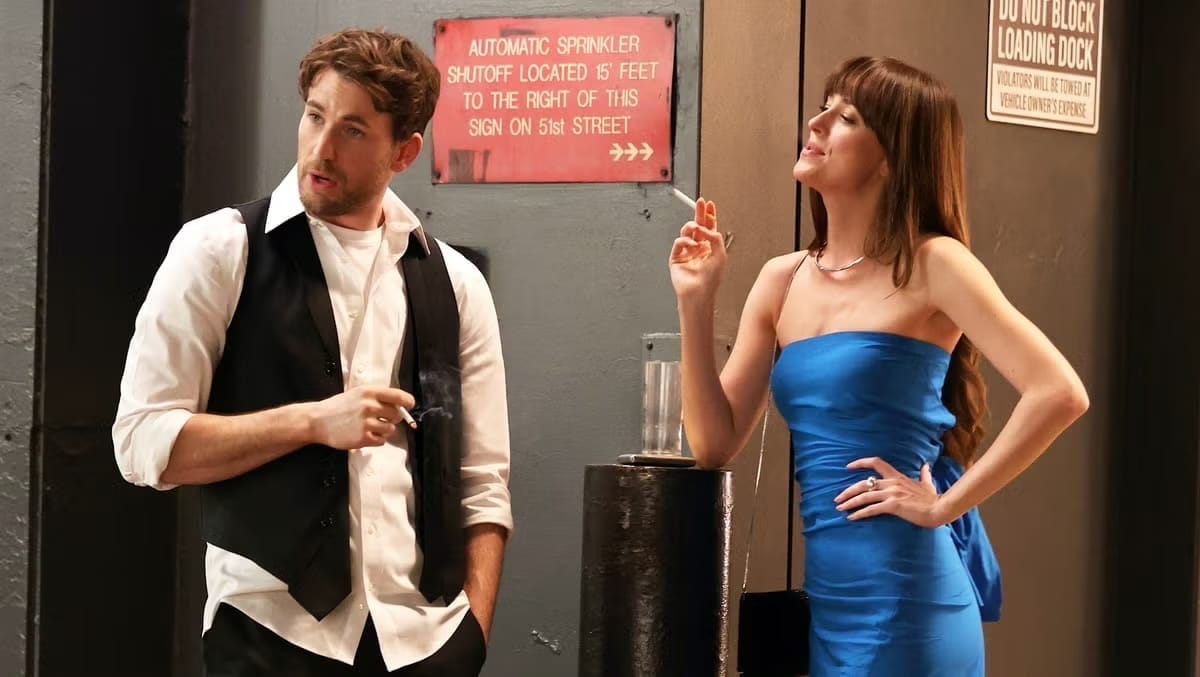
Through these interactions, we get to see both “old” Lucy and “new” Lucy.
Presumably due to a lack of an ability to read social cues, mixed with the fact that he is a wealthy and privileged man, so he is unused to not getting what he wants, Harry continues to court Lucy.
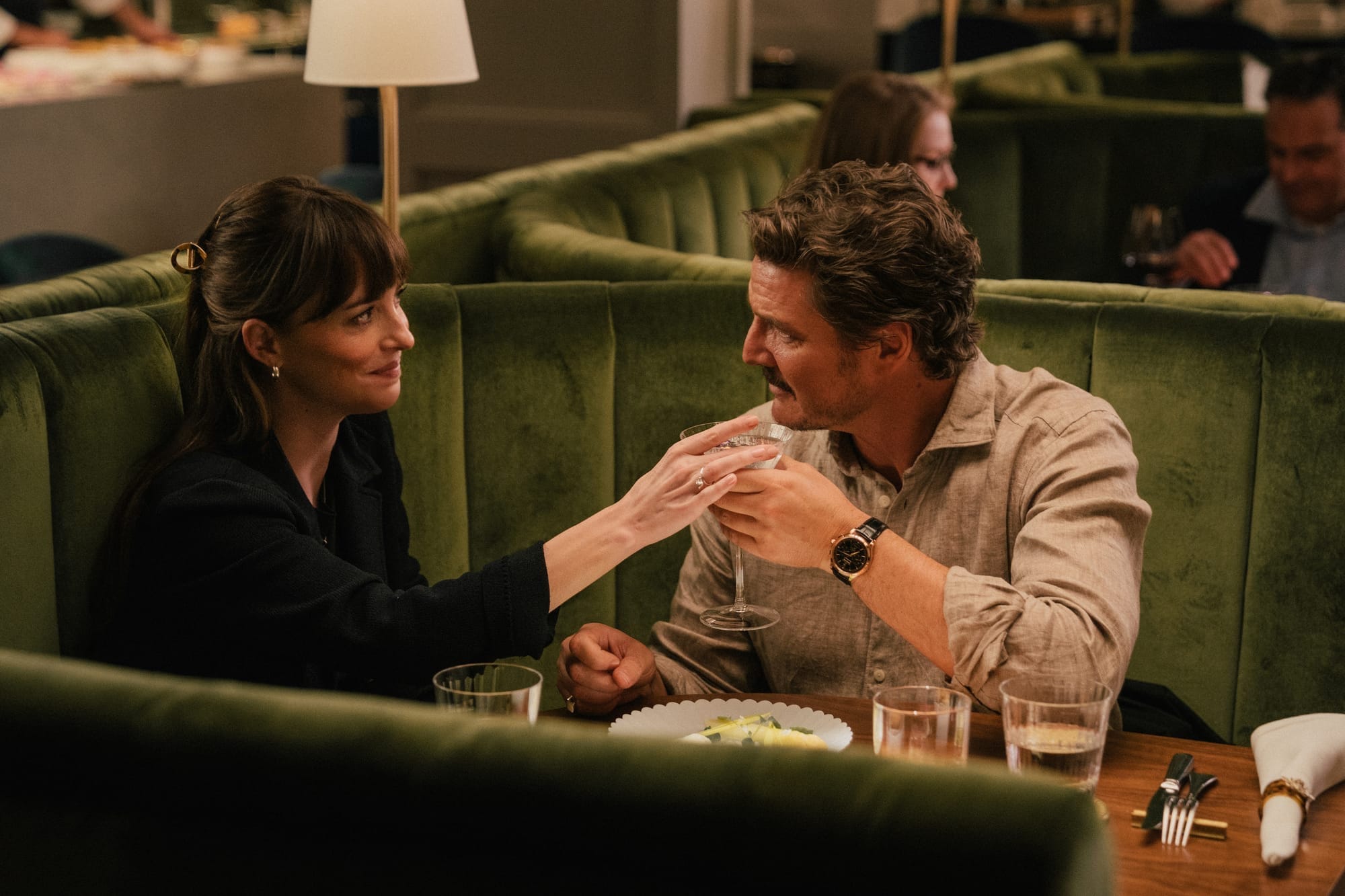
He takes her to upscale restaurants that, from what I saw of the food, look amazing. Still, Lucy is hesitant because she’s somehow only partially interested in Harry, whose other job is being the Mandalorian. Seriously though, Pedro Pascal is so charming and handsome that the whole thing is unbelievable, and while I know this was partially the film’s intent, I don’t know if Song meant to so clearly convey that Lucy is the entire problem here. The ENTIRE problem.
Anyway, their relationship becomes official, and Lucy’s love life seems to finally reflect her success in her professional life. But then Lucy is informed that one of her clients is suing Adore because the match Lucy made for her assaulted her after the date, and now she is shaken. Even worse, when Lucy seeks out the client to apologize, looking for redemption, she is rebuffed. And I think I could probably rant for hours about the way white Americans immediately center themselves in problems that are not about them, and the way they will big-baby-public-cry and become absolutely relentless should they be denied what they believe is their due absolution, but... I will abstain...
Anyway, now racked with guilt, on the eve of a big romantic trip to Iceland with Harry, Lucy finds an engagement ring in his luggage, and then discovers that in his past, he has undergone a $200,000 tibial lengthening surgery in order to increase his height!
What!?!?
A tibial lengthening surgery?
Holy shit, that is the saddest thing I have ever fucking heard of. Lucy denies it during their resulting break-up, but she basically gets the ick the moment that she discovers this, big time, which is 100% understandable.
But, since Lucy had to sublet her apartment for the Iceland trip—a detail that feels weird and a little unbelievable, as she was only going to be gone a few weeks, and also she was on a paid vacation from work, but it's overshadowed by an issue that is common to these kinds of shows/movies, known as “The Friends Paradox." This is where your main character makes $80,000 a year, and yet, is somehow able to afford a really nice apartment in Manhattan, but... whatta ya' gonna do? Fuck it, right? The whole thing is a complete fantasy. She might as well have wings.
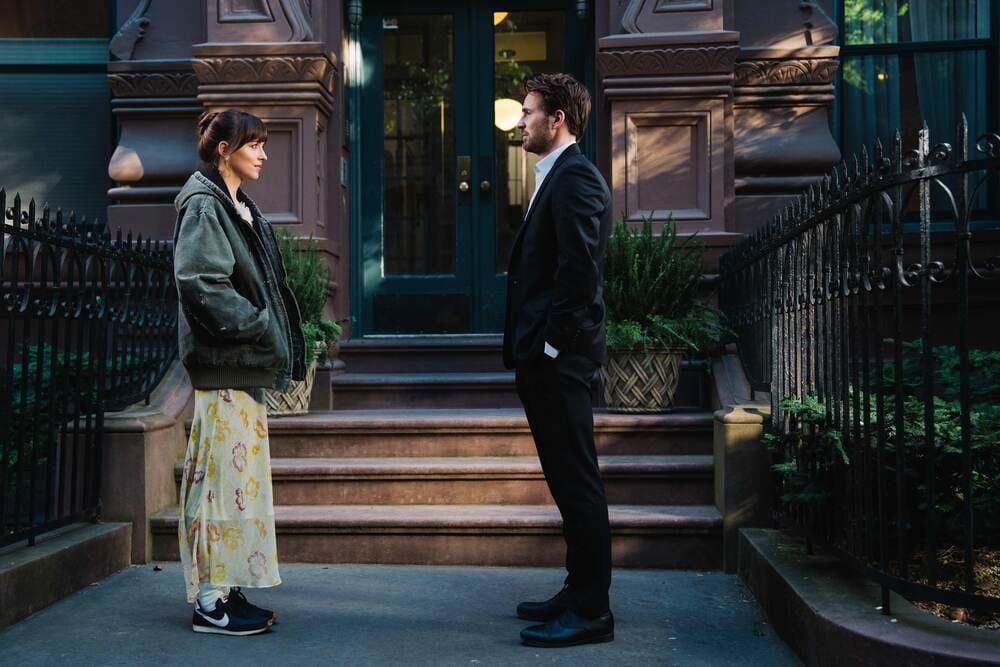
So, with no apartment, she visits John, which really feels more than a little like a “oh gee, what a coincidence” type of thing, as she has clearly been hot for ex ever since she ran into him.
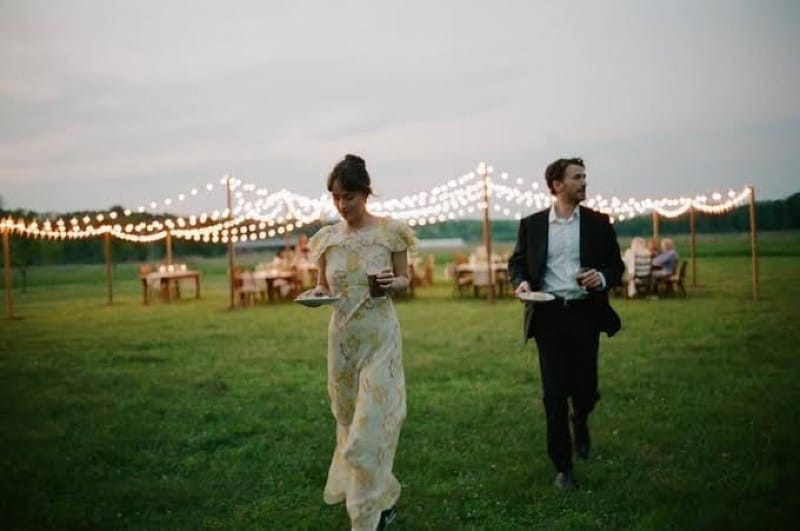
The duo decide to roadtrip aimlessly upstate, and they come across a barn wedding that feels like a Restoration Hardware pop-up, so they crash it. They end up having a super romantic time that starts with some cake, some dancing, and some kissing, and ends, because again... Lucy is The Whole Problem, with hurt feelings, mostly because John admits that he still loves her, Lucy admits that she just doesn’t want to date a Poor anymore.
Then, as the pair drives in uncomfortable silence back to NYC, Lucy receives a panicked call from her client, who then tells her that the guy who assaulted her is outside of her apartment, that she has no one to call, and the police are refusing to intervene since he has not broken in. This absolutely rings true, because as we all know by now… Police don’t deter crime, they don’t stop crime, and they certainly don’t solve crimes, and other than murdering civilians, don’t seem to do much at all, except stand around and scroll their phones, because as the Supreme Court ruled... police are under no obligation to protect or save you.
But I digress...
So, as recent events in Minneapolis have shown us, we only have each other when it comes to protecting ourselves, Lucy and John rush back to NYC. When they get there, they discover that the guy has already left, and the woman is safe. She and Lucy reconcile, and Lucy helps her file a restraining order. Later, Lucy realises that John has been waiting outside the whole time, keeping watch. Before they part ways for the night, they make a few more romantic speeches at each other.
Blah, blah, blah. Kiss, kiss, kiss. Happy times. Shit works out. And in the end, we see a bunch of couples at the City Clerk’s office, including Lucy and John, as they get their marriage licenses.
Grossing over $108 million worldwide, making it A24's third-highest-grossing film, and also writer/director Song's highest-grossing film (something that is less impressive when you remember that this is her second film), the seemingly pretty widespread expectation that this film was going to be the much easier to imagine fluffier version of what this film actually is led to a lot of people being disappointed in it. These reactions don’t surprise me as we should never forget the true lesson of Game of Thrones…
People may claim that they want non-traditional stories, with different points of view, and audacious and unexpected endings, but the reality is... they just want the same cotton candy, over and over and over again. And they will fucking riot if they don't get it.
So, yeah, it's clear that a lot of people expected Materialists to be more cheeky, and much more in line with more traditional rom-coms. Just like it's clear that, when it turned out that the film was actually more of a "realistic" look at trying to find love in a materialistic world, people got mad. And I get that, somewhat. People weren't prepared for a more cynical modern day spin on Jane Austen-like stories about the pressure to partner up for financial security. They wanted the story of a big city gal just trying to have it all, juggling work, sassy friends, and sexy boys, Thursdays at eight, central and mountain, on the CW. So they were upset.
Was that on them?
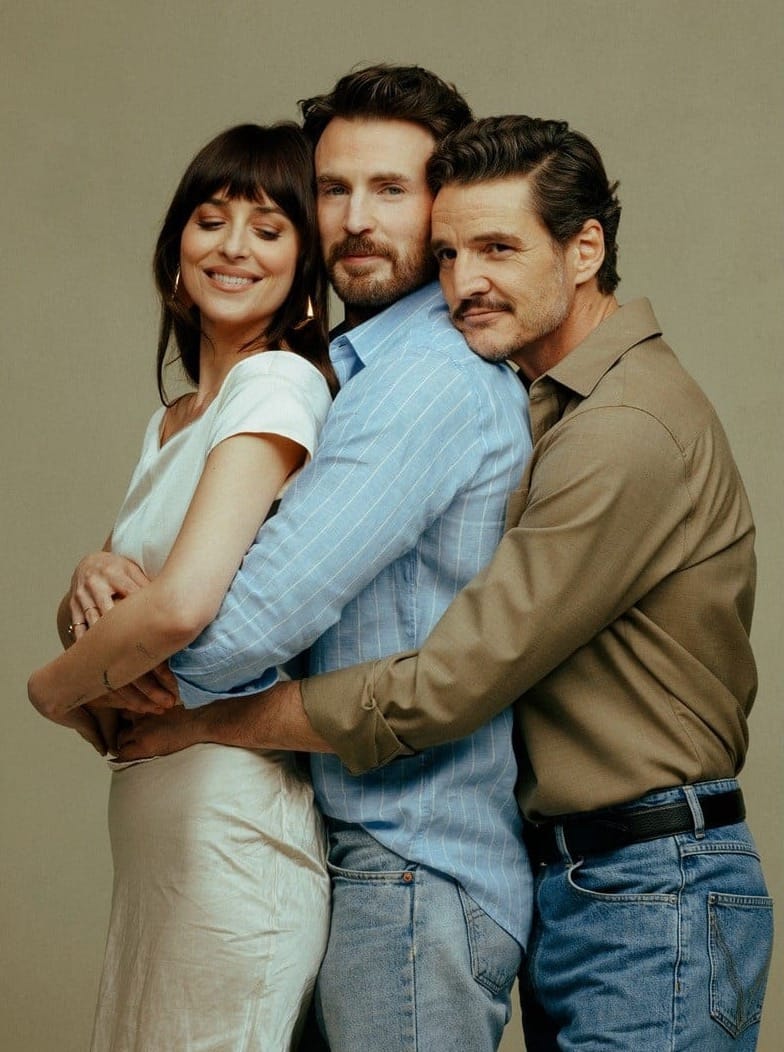
Maybe not totally, at least in this case. The marketing certainly didn’t reflect the reality of what the film was about, and the trio of stars were just way too charming together while doing press, but still... expectations are bullshit. Once the lights go down, you have to let that shit go and judge the thing on its own actual merits.
That said, I don’t know if the film fully worked.
It was brutally honest, yes, and didn’t flinch away from clear depictions of everyone’s quite ugly flaws, resulting in a much sadder, much more doomed look at romance, despite its cavemen bookends and marriage license ending. Yes, you read that right... Caveman bookends. But then, as the bookends are all about two cavepeople finding love in a dangerous world, maybe that was the whole point…
"Take the leap for love. Why not? The world’s fucked anyway.”
I did like how Lucy is presented with two very reasonable choices, instead of one obviously being a shit choice, and the other being Prince Charming. This was a real testament to Celine Song’s ability to write characters who feel real. Everyone here is messy and complicated, and while her dialogue is a little too poetic and honest at times, sure, they all felt real, at least in that sense.
The weird part of the whole thing, the one sour note that I saw? While Dakota Johnson is perfect for the role–absolutely exuding a sophisticated, long-legged, flowy-top glamour as she strides about the streets of Tribeca looking effortlessly cool and beautiful–her very flat delivery, which I assume is meant to show how Lucy is guarded and a bit cynical, instead makes her seem very cold, and it's more than a little off-putting. It throws off all the chemistry. I mean, why do these guys work so hard for Lucy's affections when she blows up literally every encounter with a sudden cold and cruel appraisal of them and their possible future? She's just... a fucking downer, man, like... all the time. How about we just enjoy our squid ink pappardelle and maitake karaage in peace, huh, Debbie Downer?
Also, fair warning...
Dasha Nekrasova, the well-known Russian asset, and a very typical shithead hailing from the dirtbag left influencer-podcaster grifter scene, who is an entitled and privileged piece of shit, as well as an antisemitic bigot Trumper "independant thinker" and self-declared Nazi lover, a woman beloved of the American Right because she is a 100% accurate representation of their views and values, does have a very, very small part in this film. If you blink, you’ll miss her very brief grasp for mainstream fame before she was deservedly kicked to the curb. Hopefully we will never hear from her again, but knowing white America, due to currently living in their bigot hell world of white Christian nationalism, I’m sure we won’t, because she is them, and they are her. Either way, that Celine Song would cast her at all is something to remember in the future.
"Oh, but how could she know?" you whine, "It's a big production." First of all, fuck you. Secondly, this the world we live in. Vet your people, or you risk signaling to the world that you don't actually give a shit who you break bread with.
But again... I digress.
In the end, I applaud the attempt to make something in the Rom-Com genre that questions and considers what we value and the societal expectations that we allow ourselves to participate in, all while showing the kind of clinical equations that so many people seem to apply to the question of love and happiness.
But...
The ending feels so rushed, so perfunctory, so unremarked upon, so unexamined, that it seems to undermine all those previous questions, rendering them moot and pointless. The only question you're left with, is how does this ending connect to the dramatic tension of the story? And the only answer is... Seemingly not at all.
Unfortunately, The Materialists is a pass.