9 to 5
What a way to make a movie.

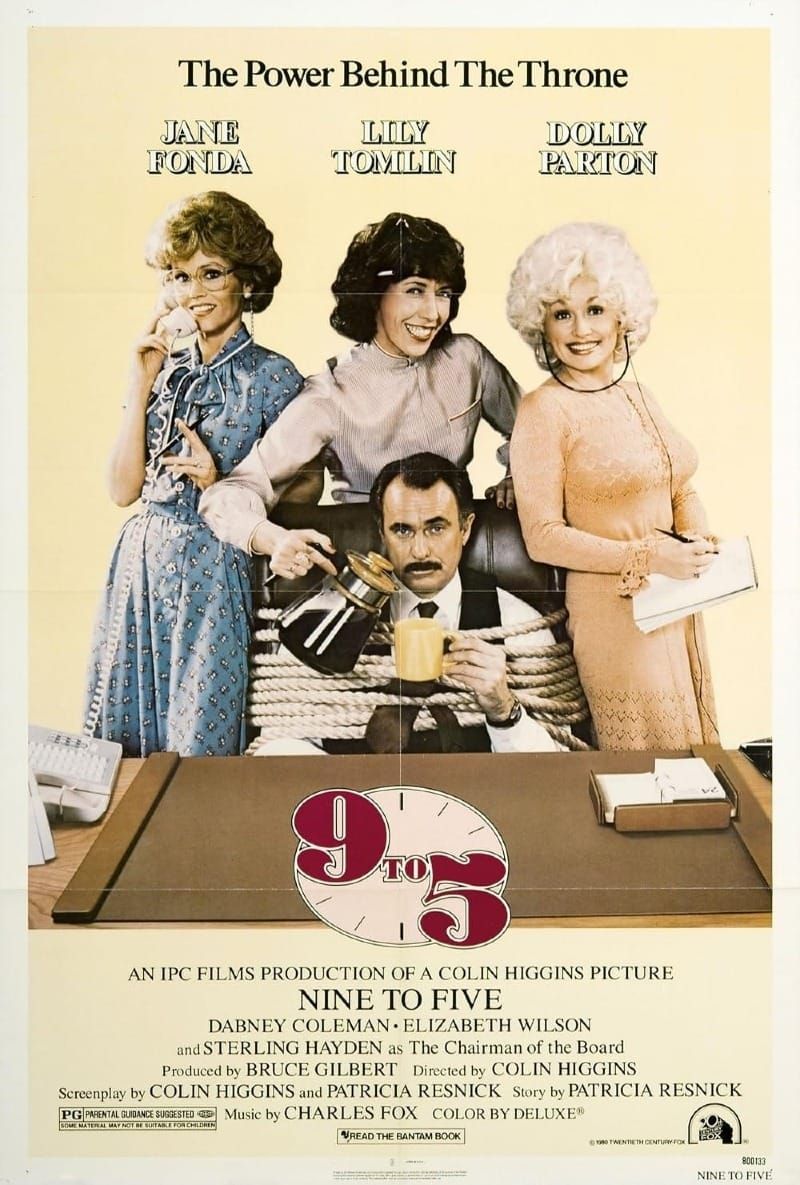
Three female secretaries decide to get some revenge on their sexist male boss by abducting him and running the business themselves.
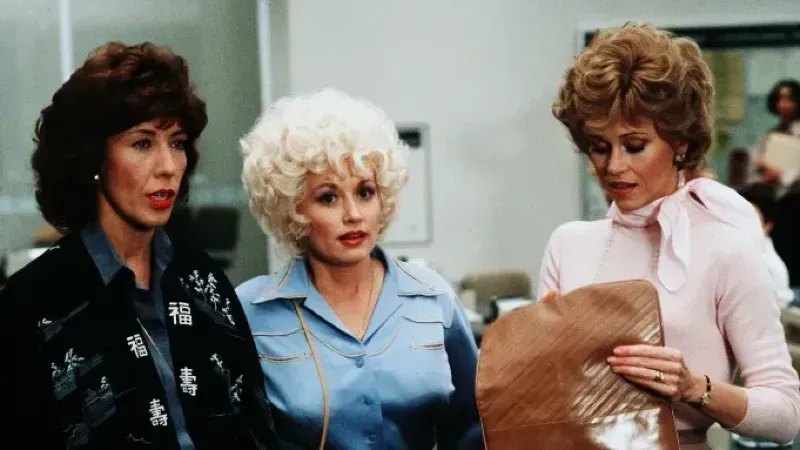
In celebration of Labor Day, as well as the unfortunate passing of the legendary Dolly Parton, I decided to watch 9 to 5. I don't think I've seen this film since it first aired as a Sunday Night Movie on one network channel or another back in the 80s, or maybe when it was on cable during one of the few times when we had that as a kid... either way, I haven't seen this movie in 40-plus years, easily.
So it felt like a good time for it.
A 1980 comedy directed by Colin Higgins, from a screenplay by Higgins and Patricia Resnick, 9 to 5 stars Jane Fonda, Lily Tomlin, Dabney Coleman, and Dolly Parton in her film debut.
Initially conceived as a drama by Jane Fonda, a tale of working women in the modern office setting, from stories she had heard from women friends in the labor movement, especially women who'd begun work late in life due to divorce or being widowed, Fonda was also inspired by 1940s films which featured multiple female leads. She has said that she then did "a lot of research into working women" and "discovered" that secretaries are often not treated with much respect, and that they often end up taking care of the boss at work, filling up his car, getting his coffee, buying presents for his wife and mistress, etc., so the driving idea was to make a movie about how you can run an office without a boss, but you can't run an office without the secretaries. This was to be Fonda's first movie for her newly formed production company, IPC Films. But then she basically chickened out, since stating that she was "super-sensitive to anything that smacks of the soapbox or lecturing the audience," and that the film started to feel "too preachy" and like "too much of a feminist line." So the nascent film was turned into a comedy, but in the hopes that it would still be a labor film, if not more of a new kind of one, different from films like the Grapes of Wrath or Salt of the Earth.
All of which seems presumptuous and vainglorious, and clearly stemming from a surfeit of privilege, not too mention despicable cowardice, especially in light of the actual film that resulted, with the whole change in tone itself seeming like it was done specifically in the service of the patriarchy, but whatever...
Dream big, Jane.
In the end, the whole thing turned out to be a kind of star vehicle for Parton, who definitely deserved the accolades. Released in December 1980, Parton received two Golden Globe nominations as a result, one for Best Actress, and the film ultimately grossed $103 million worldwide. This was a huge amount of money for the time, and it made 9 to 5 the second highest grossing film of that year, after Star Wars: The Empire Strikes Back.
And in the time since, 9 to 5's legacy has continued to live on.
There was a sitcom, which aired from 1982 to 1983 and then again from 1986 to 1988. There was also a short-lived and unpopular Broadway musical. A possible sequel has lingered in development hell for decades, and at this point probably won't happen. There's a potential reimagining in the works by Jennifer Aniston's production company, Echo Films, which is reportedly looking at Ariana Grande, Sydney Sweeney, and Zendaya for the leading roles, but that's probably just the usual pie-in-the-sky hopeful Hollywood rumor meant to drum up studio interest. I don't think it will happen. Both Ariana Grande and Zendaya have moved past this level of project, especially if the script isn't there, which it isn't, or it'd be moving forward based on the power of the IP alone, and Sydney Sweeney's star is already setting amongst non-bigot audiences, and is settling into place over the MAGA universe, next Chris Pratt, David Boreanz, and the works of Tyler Sheridan, so I wouldn't hold my breath for that one either. Also, there was a Turkish adaptation in the 1980s called Patron Duymasın (Don't Let the Boss Find Out), where other than the fact that the Tomlin and Fonda roles were played by men, the script is otherwise basically the same.
My point in bringing up all of these less than stellar examples of what came after, is to point out that the only real legacy this film has is its incresdible theme song, which is an all-time classic.
Number one on the Billboard Hot 100, nominated for an Academy Award and a Golden Globe, winning a People's Choice Award and two Grammys, "9 to 5" is a certified platinum hit written and recorded by Parton. It's one of her biggest hits ever. It might even be her signature song. She wrote it on set, after she discovered that she could use her long acrylic fingernails to simulate a tyewriter sound, and then used that to form the beat.
The song is basically the entire reason that even anyone remembers this film.
So...
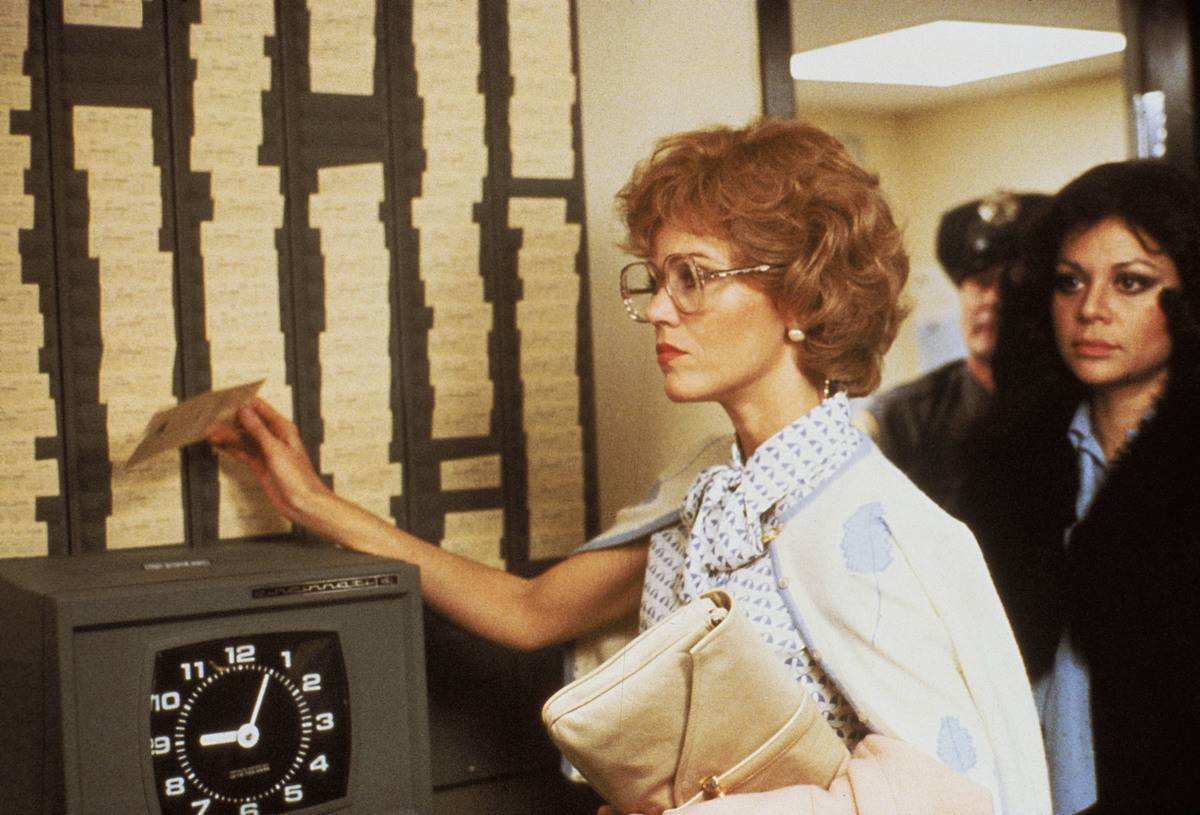
Mousey and adrift, housewife Judy Bernly has found herself at an unexpected crossroads in life after her husband divorced her so that he can wear velour track suits while driving a younger woman around in an MGB. Alone in her apartment, Judy has had to get a job, the first job she’s ever had.
The film begins on her very first day as a secretary at Consolidated Companies.
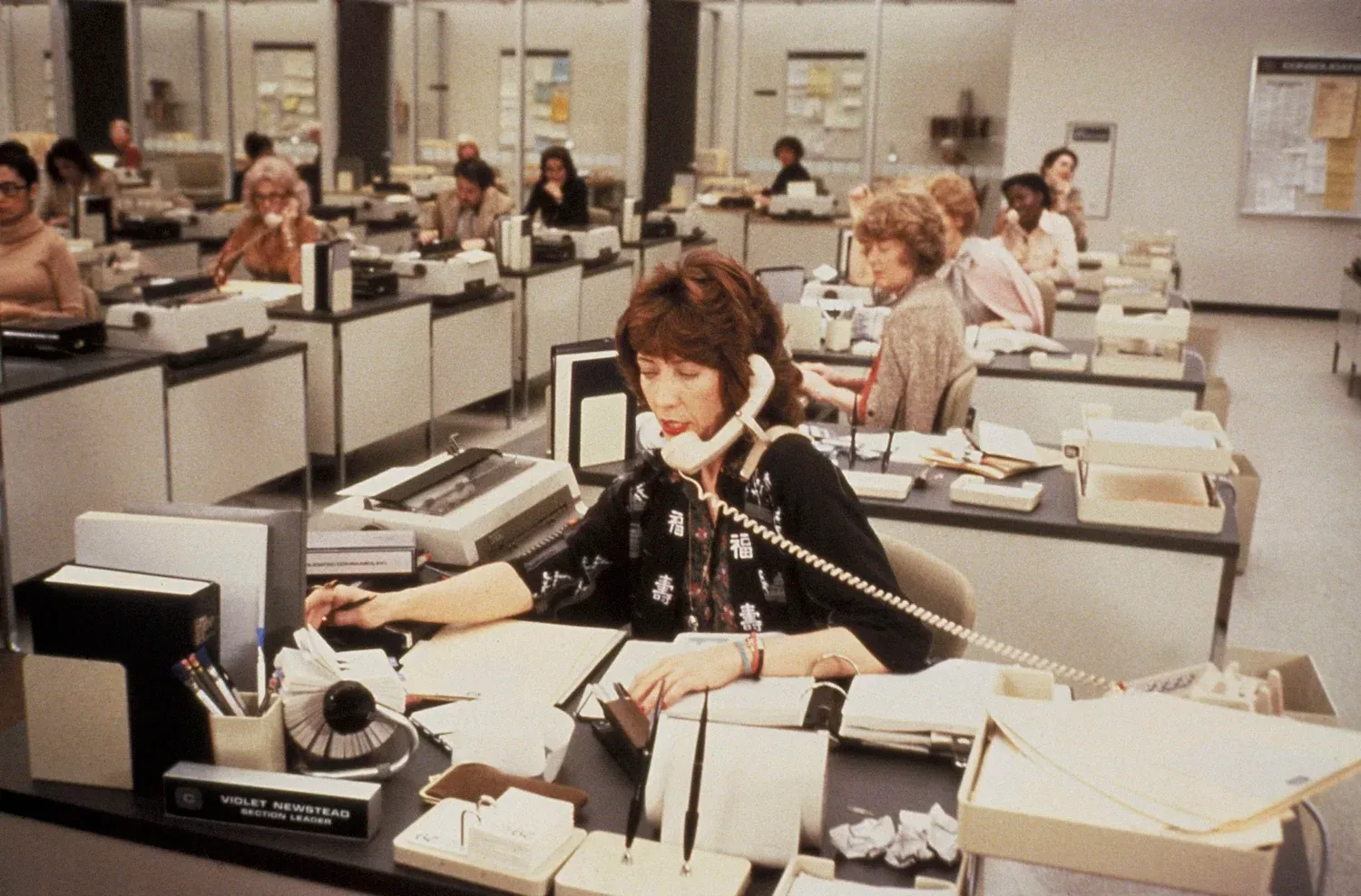
Once she arrives, Judy is taken under the wing of the sharp-tongued and uber-competant widow, Violet Newstead. Violet has worked at Consolidate Companies for years. She knows all the ins and outs backwards and forwards, and is hoping that she will finally get the big promotion she's been chasing for so long now.
Meanwhile, the busty little down-home spitfire and literal ray of southern sunshine in the drab confines of downtown Los Angeles, Doralee Rhodes, is the secretary to the manager of this entire floor of Consolidated Companies, vice president Franklin Hart.
The bitter gaggles of office gals all sneer and whisper about Doralee and shun her, forcing her to eat lunch alone, because they all think she is sleeping with the boss. This is very obviously due to the fact that she is not only much prettier than all of them, but she's also 100 times nicer than them too.
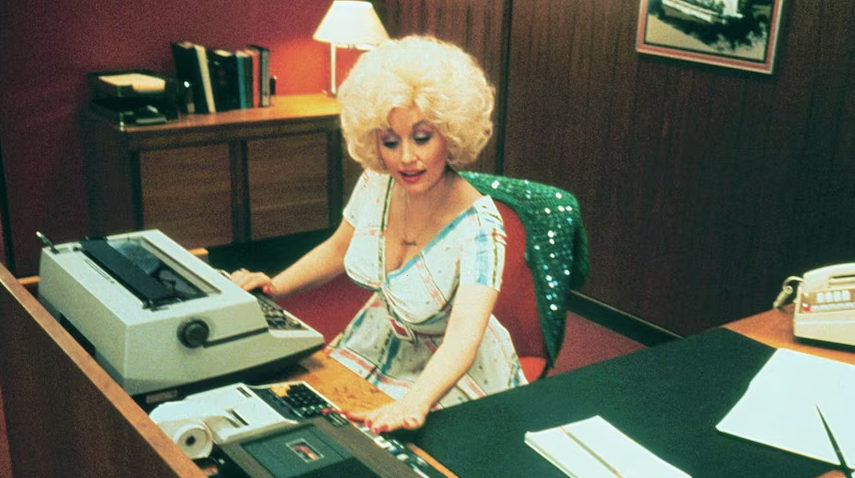
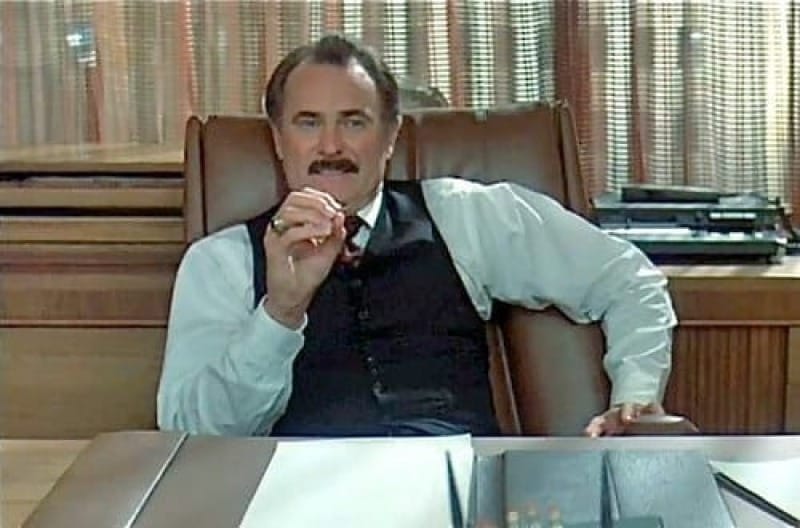
Franklin Hart, meanwhile, or Hart, as they all call him, is an egotistical, sexist butthole who is desperately trying to woo Doralee every chance he gets, despite the fact that they are both married. Unfortunately, Doralee needs the job, so she just ducks and dodges his relentless advances.
In short, Hart is a shit.
He yells at Judy when she can't figure out the Xerox machine, even though it's her first day. He passes Violet over for a promotion again, giving it to the less-qualified Bob Enright. He fires another woman after learning from his snitch of an assistant, Roz, that she discussed her salary with a co-worker while in the bathroom. Then, from Judy and Violet, Doralee finds out Hart's encouraging the rumors that they're having an affair. Like I said, he's an absolute shit.
After such a rough day, Judy, Violet, and Doralee all hit the bar together to drink away their frustrations. And this is where the film makes... hmmmmm, let's call it a few odd narrative turns or two.
The three women go to Doralee's house, where they smoke a single joint, that Violet got from her son, and get super-duper high, total giggle-fits, and then go on at surprisingly great length about the various kinds of fantasy revenge they would take on Hart, if they were given the chance. Judy would hunt him like a Big Game hunter and mount his head on the wall. Doralee would sexually harass him herself, then hogtie him rodeo style, and roast him over a fire. Violet, dressed like Snow White, and along with the help of some disneyfied medieval cartoon animals, would poison his coffee and then throw him out the window.
Let me tell you, this is some primo late 70s/early 80s pot "humor" at its finest, people, and like I said, it goes on for a while.
Finally, the next day, distracted and a little slow after getting soooo high, Violet accidentally does just what she fantasized. She puts rat poison in Hart's coffee, after having mistaken the rat poison box for the nearly identical-looking box of coffee sweetener.
And here’s where I have some questions…
Chiefly, why is there rat poison in the employee break room of a downtown L.A. corporate office building? And why is it stored in the cabinet next to the “nearly identical-looking” coffee sweetener? Why isn’t it under the sink? Now, to be fair, storing poison right next to coffee sweetener does sound like something Boomers would've done, which is why we ended up with warning labels on everything, like how lawn mowers all say "not for use when trimming hedges" but seriously, does this building actually have a rat problem that is so bad that the employees of each floor have to be ready to deploy poison at a moment’s notice? Okay, sure, maybe in NYC in the 80s, maybe, I guess? I don't know, but in downtown L.A.? Was this a thing back then? Is it a thing now? In corporate office buildings? And even if it really is a thing, again... why the fuck is the rat poison not only in the breakroom, but in the same cabinet as the food stuff?
I get it, I get it... because of the potential for "comedy." Right. Got'cha.
So...
Luckily, before Hart can drink any poisoned coffee, his chair breaks, spilling himself and his coffee onto the floor, where he hits his head and knocks himself out. At the same moment, Violet realizes her mistake and rushes to Hart's office, hoping to stop him from drinking the poisoned coffee, only to find him flopped out on the floor. Assuming that he’s been poisoned, she and Judy meet Doralee at the hospital, convinced that they’re all about to be arrested for attempted murder. In a massive coincidence, just as they are arriving, they overhear a doctor pronouncing another man dead due to poisoning. Also, side-note... the dead guy may have been a mobster who was killed in a mob hit?
Anyway...
Panicking, and believing the dead man to be Hart, and that he’s dead because she poisoned him, Violet does what any normal person would do…
She steals the body in order to prevent an autopsy.
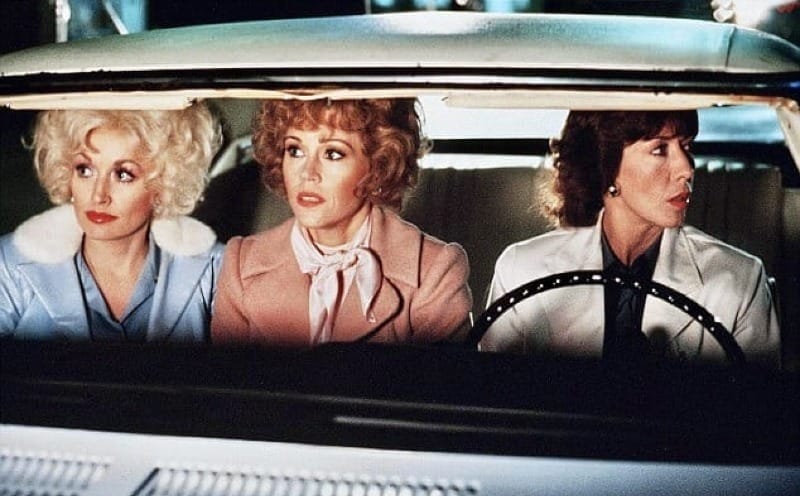
She then farcically pushes the dead body on a gurney all over the hospital, all while she is poorly impersonating a doctor, as she tries to find a way to get the body out of the building. She finally does, and she stuffs the body into her trunk. Then she, Judy, and Doralee race off, burning rubber in Violet’s 1969 Buick Skylark Custom. They then tear ass all over Los Angeles like they're the Dukes of Hazard. Finally, a cop pulls them over, not for yee-hawing around Culver City, but because they have a busted taillight. He almost searches their trunk, but they manage to wackily bluff their way out of that. Arguing wackily, they end up crashing the car. When Doralee goes to get the tire iron out of the trunk, she sees that the body is not actually Hart. So, having realized their mistake, they’re like “oopsey," and they drive back to the hospital, wheel the stranger’s dead body inside, and then leave it in the men’s room for someone else to find.
I don’t know how long this whole corpse-stealing sequence went on for, but it not only felt like forever, it felt like a scene from an entirely different movie that was just dropped into the middle of this film.
And then it's just done.
But the weirdest part yet? It's an important plot point!
The next morning, all three women are shocked when Hart comes stomping into work, since, despite stealing the wrong body, they still believed that they had killed him. Confused, they meet in the ladies’ room, where Doralee explains that Hart hit his head, but did not drink the coffee. Relieved, they agree to meet for happy hour at the end of the day. Thank goodness that worked out! Their corpse-stealing and boss-poisoning days now over, everything is right as rain.
Unfortunately, Roz overhears their conversation and reports it back to Hart.
Hart, ever the shit, summons Doralee to his office at the end of the day, and he gives her a choice: fuck him, and he won’t report the three of them for attempted murder. Doralee hogties him and stuffs a scarf in his mouth to keep him quiet. He tricks Judy into loosening the binds, so she shoots at him with Doralee's handgun. The women then discover Hart has been selling inventory and pocketing the cash, so they decide to blackmail him into keeping quiet.
Do you know what this means? It means that 70-ish minutes into the film's 109 minute runtime, it's finally getting to what it's supposed to be about.
BUT...
When they’re told that the invoices they will need to prove Hart's crimes will not arrive for 4 to 6 weeks, the three women kidnap him. They hold him prisoner in his bedroom, using a contraption that they cobbled together seemingly out of Violet's garage door opener and some BDSM sex gear, leading to a situation that has most likely given birth to a whole host of pornos to this very day.
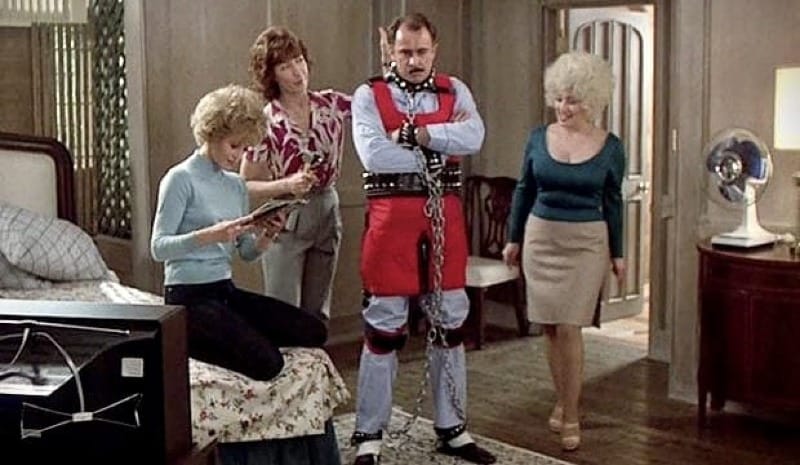
In order to protect their jobs, avoid jail, and blackmail Hart, the trio then send Hart's wife away on a cruise, Roz to a conference, and then they proceed to forge Hart’s signature in order to implement several new programs that are popular with the workers. This includes an in-office daycare center, the removal of the punch-clock, a flexible work hours policy, painting the office in theoretically better colors, some new furniture, some cubicle walls, equal pay for everyone, better snacks, a job-sharing program that allows employees to work part-time, and a generally more relaxed in-office attitude.
It’s a workers’ utopia!
...A workers’ utopia that is for the ultimate benefit of the bosses, but still.
It’s a workers’ utopia!
But days before the invoices arrive, Hart's wife returns from the cruise and frees him, thinking he’s stuck in an exercise machine. Hart quickly buys back all of the inventory he sold, rendering their evidence as useless. But before Hart can report Judy, Doralee, and Violet to the police—presumably for kidnapping, because the attempted murder charge would’ve been nearly impossible to prove, and honestly, who'd believe the kidnapping charge? Imagine Hart explaining this ludicrous plot to the cops. “They locked me in a combination sex swing/garage door opener and started doing nice things for the office!” And what evidence does he even have? "My assistant overheard them in the bathroom after the fact!" Plus, the resolution to the whole plot is "My wife came home early and freed me from the sex swing they chained me to!" which makes him sound like he's making up a story after his wife nearly caught him cheating. But whatever. It's a farce. Allegedly. I get it.
But as I was saying... before Hart can actually report Judy, Violet, and Doralee to the cops, the chairman of the board arrives. Now, for some inexplicable reason, the film decided to depict the chairman of the board for this company, Consolidated Companies, a company that is based in Los Angeles, as this white-suit-wearing, Colonel-Sanders-beard-having, Foghorn Leghorn-sounding motherfucker. I don't really know why they made this particular choice, other than, much like when it comes to pot humor, its simply a vestige of an era when "go broad!" was the "yes and..." of comedy circles.
Anyway...
Colonel Buford T. Beauregard Mint Julep Tennessee the Third, or whatever the fuck that this guy's name was, blusters in and (Gomer Pyle voice) surprise, suprise, suprise, he immediately congratulates Hart on all of the improvements that he has made to the office. The ladies let Hart take credit for all of it, and Hart, confused, but ever the shit, doesn't argue because those changes have apparently resulted in office productivity going up a bunch of numbers. (Although the chairman and Hart both agree that the “equal pay“ obviously part has to go.) As a reward for his good work, the chairman promotes Hart to his team. This means Hart will be going with the chairman down to Brazil in order to work on some vague, but multiyear-long project, which the film treats as if Hart was just told that he is being shipped off to the absolute asshole of the Earth. But Hart has no choice, as to refuse means he'll get fired, the worst fate imaginable for capitalist America, so he accepts, and then immediately leaves with the chairman. As the elevator door closes, Hart gives the ladies the kind of look that says that he knows that he's just been out-maneuvered and fucked over, and that he regrets everything, instead of having the face of a man who has just been promoted, so I guess this is a victory for the ladies.
The office is now free of Hart's tyranny, so they have champagne at work.
A postscript states that Violet becomes vice president, that Judy marries the Xerox representative, Doralee leaves the company to become a country & western singer, and Hart, meanwhile, is abducted by a tribe of Amazons in the Brazilian jungle and is never heard from again, because why not end on a bit of racism?
The End
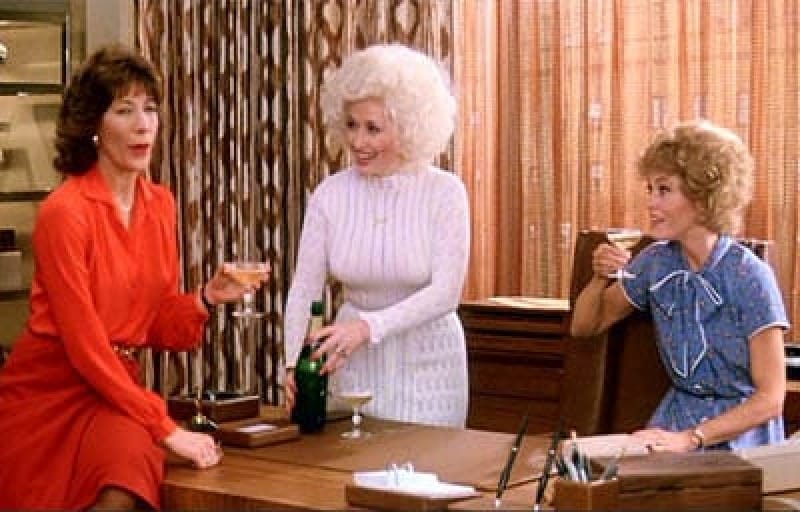
I’ve seen this film before. I know I have. It was a long time ago, yes, but I've definitely seen this movie before. And there were multiple moments in the film that I definitely recognized upon seeing it this time. Plus, it obviously occupies a place in pop culture. So going in, I knew what this movie was going to be. I knew that it was going to be something in the same vein as The Office and Office Space, maybe a little more farcical, sure, but still a "Here's life in the modern American workplace" very relatable kind a thing. This is what I was expecting, because this is what I remembered.
Or at least, what I thought I remembered.
Because I was shocked to discover upon revisiting the film that at least two thirds of this film is just... not this. Not at all. Like I said, I remembered that they worked in a shitty office and got no respect, so they kidnap the boss and then run the office in his name. I remembered that. That's what the film is supposed to be about.
This is what's on the poster.
But I had no memory of the fact that the majority of this film actually has nothing to do with any of that, and instead focuses on multiple dream sequences, as well as an extended sequence where they steal a corpse from a hospital, drive around L.A. with it in their trunk, and then just... take it back to the hospital and leave it in a random men's room, like whoopsey-doodle!
Two-thirds of the movie!
In fact, other than one part where Jane Fonda struggles with a copy machine, there's almost zero "office humor" to speak of. Honestly, I'm hard pressed to even call this film a comedy. I mean, it's definitely not a drama, and it has some funny parts, and this film clearly thinks it's a rip-roaring farce, but it's just not. Simply put, 9 to 5 is nowhere near as “wacky” as it very clearly believes it to be. Not even close. I was going to go on about how unfunny and weird and incredibly long the whole pot-fueled revenge fantasy sequence was, but then they steal the corpse and that just eclipses every weird moment that came before. They treat it as funny, too, which you would expect for a comedy, but the thing is... it's not. It's not funny. And I don't mean that it's creepy, or mean-spirited, or offensive. It's just not that funny. Mildly? Maybe. But it certainly isn't “uproarious” or anything. At least, not like one might expect it to be, if one were to wheel a dead body out of a hospital, and put it in your trunk and drive off with it. They don't even "Weekend at Bernie's" with it or anything. It's not like they make it wave at anyone, or act like the corpse's cold dead hand is actually their hand (Young Frankenstein) or pretend that it's drunk and passed out–or "dead" tired–when questioned (Commando), or that they have to pretend to make out with it, so the cop won't get too close (Clue).
Nothing! It's just... in the trunk... for a little bit.
The whole sequence is just this series of small encounters where they are almost caught with a dead body of a stranger, that they are not supposed to have, that the film treats as "wild" while it's happening, despite the very evident "low key" tone on the screen, and then it's done, no harm, no foul, and they all walk away from it like they'd just spilled red wine on the new white carpet at a party, so they covered it with a rug and slipped away without the host noticing.
It's so weird! It's all so weird.
And the craziest part of the whole thing is that the whole kidnapping plot–the movie's raison d'etre–hinges on them getting there after they momentarily steal a body, the wrong body to boot, as the result of a panicked misunderstanding due to an accidental poisoning scare, which is due to a distracted mix up, as rat poison is stored next to the sweetner in the employee breakroom, which is the result of the characters having gotten super-duper high off a single joint the night before. It's just so... I don't know. It feels to me that this script is caught between two eras, like it's the result of people who weren't "with it" who trying really hard to be "with it" but they just didn't know how to even fake it, and then you mix that with the fact that they were also people who weren't that funny on their own, who not only think they really are funny, but that they have a serious message for society too, and the whole thing just ends up so weird. And it starts out so regular too. Then it just... careens off the road. Weird event leading to weird event leading to weird event, none of which are portrayed all that noteworthy either, at least as far as comedy goes, and at the same time is all so strangely and incredibly unrealistic, which the film doesn't treat that way at all, and instead treats it like pure fucking comedy.
Y'know how you go back and watch movies like Caddy Shack and Stripes and Meatballs and stuff like that, and as you're watching it, you realize there's actually this whole incredibly uninteresting movie that is happening in the background of the film that you completely forgot about because of all the mostly Bill Murray related funny stuff that is also happening?
9 to 5 is like that.
...Just without any of the mostly Bill Murray related funny stuff.
And yet, at the same time, it's obvious that the filmmakers/screenwriters really thought this film was just absolutely packed with funny stuff too. You know this because, during the post-script–as they're telling us what happens to everyone–at the same time, the film is recapping the “funniest” moments of each character. The body-stealing. The pot fantasy. The inepitude with the copy machine. And again, it's not like these moments were un-funny, it's just that the film clearly considers these moments to be hil-fucking-larious, and they're just so wrong about that.
It's just not that kind of comedy.
Or maybe it once was? I don't know. Maybe this is just me, your mileage may vary, who knows. Maybe you still think Laugh-in and the Brady Bunch Variety Hour are goddamn hysterical.
That's not to say that the cast isn't great either, because they are. Tomlin is a comedy great, and she's doing all the heavy lifting here. Fonda does a good bit as the wide-eyed innocent stumbling out into the big bright world. And like always, Dabney Coleman is the perfect villain. Most of all, as I already mentioned above, Dolly Parton absolutely shines here. But man... what a weird movie. Weird script. Weird pacing. Weird tone. Weird jokes. Weird plot points. Weird expectations on the part of the filmmakers.
All weird.
Also, when exactly did movies stop putting the majority of the credits at the front of the film, and start putting the majority of them at the end? It used to be that the story would end, and then so did the film, almost immediately too. The film would say "The End" and you'd see the film's rating, and then the projecter would shut off and the lights in the theatre would come up, and you'd leave. This was because basically everyone involved in the making the film had already been listed at the beginning of the film during the big opening sequence.
But at some point this changed.
Nowadays, you can count on at least ten minutes at the end of the film to be credits. I always assumed that the switchover happened somewhere in the late 60s or early 70s, but 9 to 5 was released in 1980, and it’s still front-loaded with credits. I checked the time as Tomlin's character was discovering that Coleman's character had gotten free, and there was less than ten minutes left, and I was like... how are they gonna wrap this up in less than two, maybe three minutes? It turned out, the answer was A. very quickly, despite actually using almost all ten minutes left, and B. there are no end credits. That Hollywood was still doing things this way in 1980 was yet another thing about this film that surprised me.
Anyway...
That said, one of the best parts of the film is definitely the way it pushed very progressive ideas. That's cool. Even if they're all so half-baked and under-served that the impact is uiltimately negligible, and in the end adds up to nothing but a liberal fantasy of ethical capitalism, one that centers on white people, with zero awareness of its own bone-deep white supremacy and patriarchal roots, all while being completely incapable of understanding how fucked up it is that the happy ending of this film is that they get to work "9 to 5" in a diverse office that is only allowed to exist because productivity is at an all-time high, and how, because of their efforts, the white man boss gets promoted to an international executive role. Also, there was that odd little bit in the post-script. No, not the xenophobic racism thrown in at the end for funsies, I'm talking about the fact that apparently Judy's happy ending was that she marries some previously unmentioned Xerox guy? And just judging by her character, I have to wonder, does that mean that she then stops working again, goes back to being a housewife? I mean, that does seem like the implication, right? Violet and Doralee got their dream jobs, so was "being married" Judy's dream job? I guess Fonda really couldn't abide too much of a "feminist line" after all, huh?
Okay, sure, fine, I can't really blame the film for this. Attacking these old movies for being the product of the toxic ills of society is a little like complaining that films from a hundred years ago were only filmed in black and white. Or that characters in films from 30 years ago don't have cellphones.
Plus, all that having been said, I do find it to be funny (“funny”) how the majority of the shit that they get in their utopian office in this film... the equal pay for equal work, the job sharing, the flexible hours, the workplace-provided daycare, on and on, is all a bunch of things that a lot of people still don't get today.
That wasn't great to have illustrated for me so clearly.
But mostly, in the end, maybe a modern update could add the teeth that this film so clearly aspires too, and hopefully the comedy as well, but honestly, I doubt it, today's studios are even less interested in smacking the boss man around than they were in the 80s, so... c'est la vie, I guess. Time passes. Things fade away.
In the end, there’s nothing here worth revisiting, except that song.