Desert Warrior
Anthony Mackie keeps on trying…

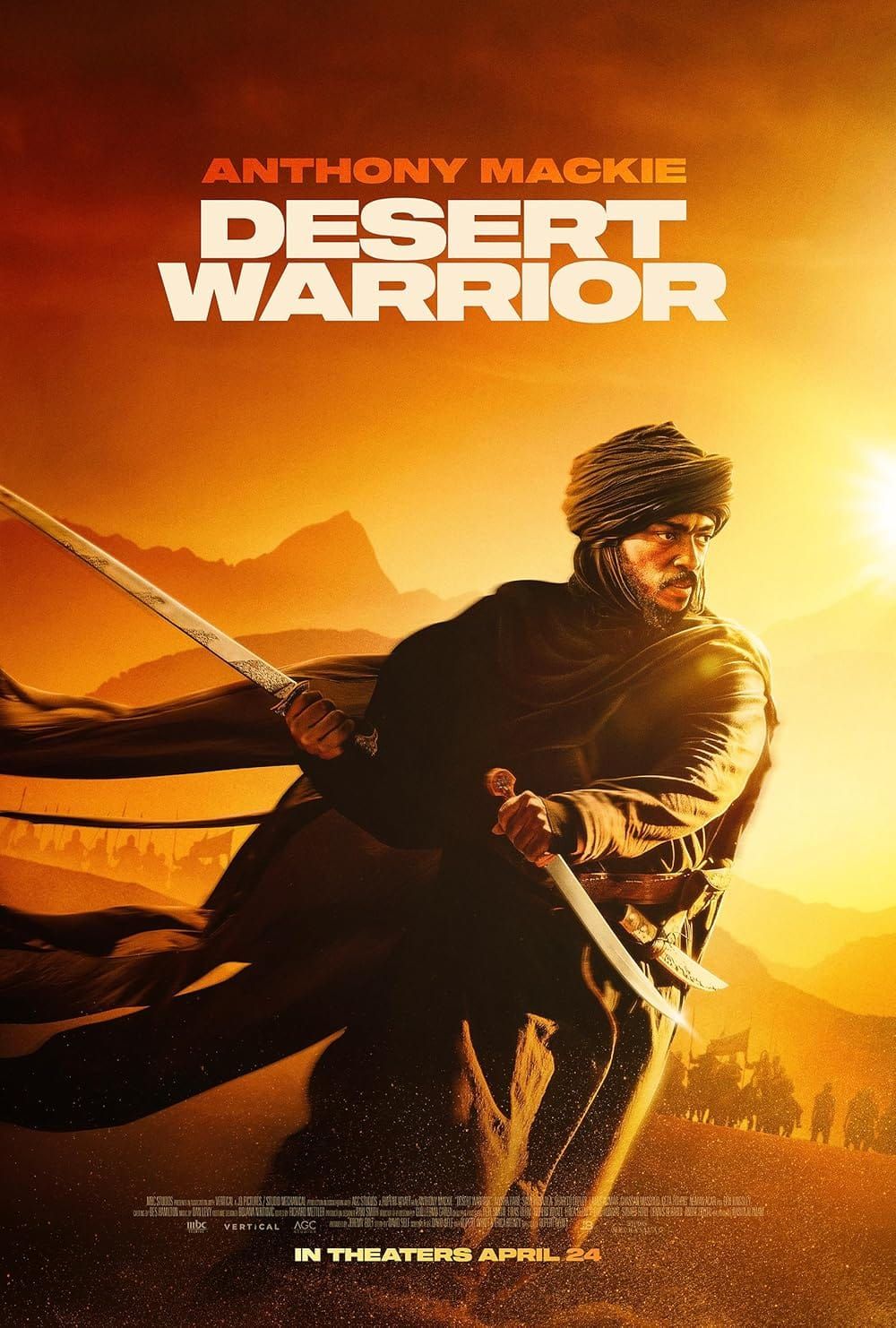
A princess and a bandit must unite the warring tribes of the desert against the threat of a tyrannical emperor.
The story of the film Desert Warrior is rooted in real-life historical events from seventh-century Arabia that led up to the Battle of Dhu Qar, which is apparently also known as the War of the Camel's Udder for reasons I couldn't figure out.
The Battle of Dhu Qar was a pre-Islamic battle that was fought between the Arab tribes and the Persian Sasanian Empire in Southern Iraq between 604 and 611 AD. Though in reality it was probably just a small skirmish, it's considered to be the beginning of the end of Persian control over Eastern Arabia, and an important part of a prolonged Arab rebellion that eventually led to Muslim conquests in the area.
This is probably why they made the movie.
So, in the sixth century, the Sasanian Empire ruled over the Lakhmid kingdom, a vassel Arab state that acted as a buffer zone against the nomadic Arab territories held by the Banu Bakr confederation. But then, in 602 AD, the Persians deposed the Lakhmid king. Some say this was due to the Sasanian emperor being a little butthurt because the Lakhmid king refused to marry his daughter, which he then claimed was not just an insult to him, but an insult to all Persian women, so they jailed the guy. The King's family fled into the desert and took refuge amongst the Banu Shayban, one of the biggest and most powerful tribes of the Banu Bakr. The emperor demanded the Banu Shayban hand over the king's family and his armor, but they refused. And after that, it was all downhill in the usual way, as no one was willing to walk away, and everybody already hated each other, so it was kind of inevitable that it would end up at the Battle of Dhu Qar.
Notice how there's no mention of Anthony Mackie's "mysterious and unnamed" bandit character anywhere here...
With a $150 million budget, Desert Warrior is one of the first major English language films produced by MBC Studios, and is the largest production, as well as the most expensive movie, to be produced in Saudi Arabia. The hope was that this film would be a leg up for Saudia Arabia's nascent film industry, and experts were flown in to train the Saudi production crews. It was a huge effort. The film shot for six months from late 2021 to early 2022 in Neom, Saudia Arabia, but afterwards it wallowed in post-production for the next two-plus years. During this time, Rupert Wyatt, the director, briefly left the film over creative differences, before eventually returning to finish it up.
In short, it was a production fraught with tension.
Desert Warrior was finally released in 2025, making less than $500,000 in its opening weekend, the worst domestic openings in history for a major film, and went on to gross less than $750,000 worldwide. A $150 million dollar budget, and it doesn't even crack a million at the global box office? Amazing. A huge flop. A historic flop.
Does the Saudi Arabia film industry even exist anymore?
I think the reason why this film died at the box office as hard as it did is probably best illustrated by the fact that I had no idea at all that this film even existed until a week or so before it was about to be released into theatres. The first time I ever saw the trailer was also the first time I had heard literally anything about the film at all, and I generally know about these kinds of things before they come out. It’s not a superpower or anything, it’s just what I do. And here we have this big "sword and sandals" type action-adventure film, a film that stars Captain America, a film that by watching the trailer I can see has a battle in it that includes attack-hyenas and war-elephants, and yet despite this, I had zero idea it even existed?
Somebody out there dropped the ball.
It begins…
1500 years ago. Arabia… a vast land where tribes fight over territory and water. In a bid to take control, Emperor Kisra II of the Sassanid Empire demands all tribal Kings turn over their daughters as concubines. Those that refuse are hunted into harsh desert, where only the strongest survive.
The film’s opening text reads like it was written by AI, originally in a different language than English, and then fed through Google Translate. Judging by the rest of the film, it wouldn't surprised to discover that this is true.
So…
The ruthless Emperor Kisra decrees that all of the Arabian kings must surrender their daughters to him as concubines, but King Al-Numan of the Lakhmid people refuses. He and his daughter, Princess Hind, flee into the desert. They are pursued by the emporer's mercenaries, a group of murderous scum led by the evil foreigner, Jalabzeen. A bandit saves them, in exchange for gold and a fancy dagger, and they are able to find refuge amongst the Banu Shayban tribe.
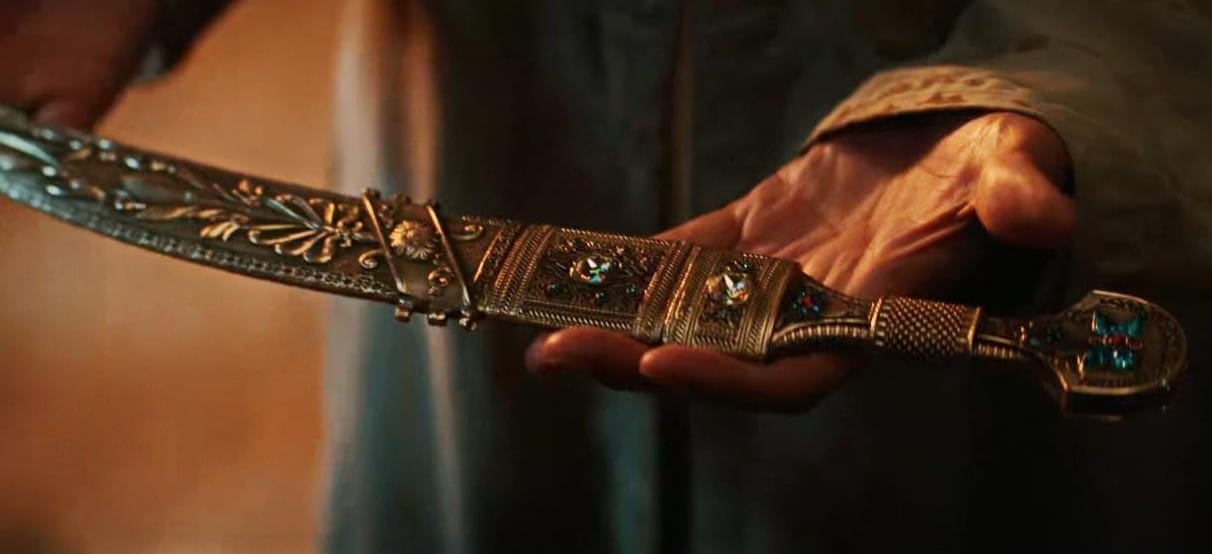
Then, when her father King Al-Numan passes from injuries sustained during the long journey, Princess Hind realizes that running is no longer an option. She steps into her role as the leader of the Lakhmid people, and through sheer force of will, she unites the unruly Arab tribes. The mysterious bandit chooses to fight with her, but this time for honor instead of gold. The united Arab armies meet at the Battle of Dhi Qar, where history shows that they will break the larger Persian Army.
Of course, in the film, the battle culminates in the bandit and Jalabzeen rolling around in the dirt, and thus, deciding the fate of the two nations.
Finally, there is this…
After the Sassanid defeat at the battle of Ze Qar and the poisoning of an army… Supreme Emperor Kisra II was himself poisoned by an unknown assassin. There are those who believe it was a concubine. There are many ways to fight a battle. While some of the story itself draws inspiration from real-life events; elements of the story, including some names, places and incidents, have been fictionalized for dramatic purposes. The real tribes of Arabia who took part in the Battle of Ze Qar were the Banu Shaybani, Banu Hanifa, Aniza, Banu Tamim, Quraysh, Banu Ujl, Banu Taym and Banu Dhuhl, amongst others.
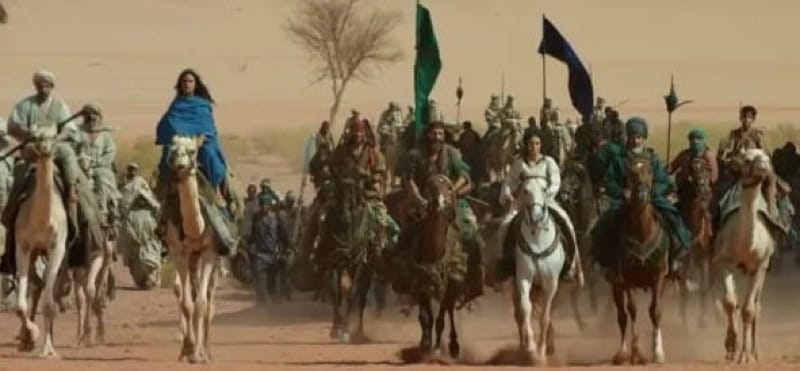
The one thing this movie makes amply clear, is that every single aspect of this production was a gigantic mess. Watching this film, it feels like a foreign film that was then shoehorned into an American release by someone who didn't really like or understand the original version, and maybe doesn't speak the original language. It’s just nonsensical in pace, in story beats, in every part.
But it turns out, that’s not the case.
Desert Warrior was directed by Rupert Wyatt, which is surprising, because they have made good movies on the past, like Rise of the Planet of the Apes, and even the film Captive State, which probably would have been a better tv show, or at least a miniseries, but still… it was good. And he who co-wrote the screenplay with Erica Beeney and David Self, who wrote The Road To Perdition and the 2010 version of Wolfman. Not the most amazing creators, sure, but decent enough, and that aside, the fact remains... these are English language people who write English-language films, and yet, this film is a supposedly English Language film that feels like it was translated from a different language, and poorly too.
So strange.
Because another thing that's clear here is that this is a film wanted some star power. This film wanted a big name through which they could sell this middling historical epic to not just the global market, but to the American market as well. It's obvious that the Saudis then took all their influence and their opulence and their oil-well riches, and went looking for a well-known actor that they could throw some money at, someone big enough to be a name, but not big enough to have all that many other options at the moment, and maybe most importantly, isn't upset at their numerous human rights abuses.
They found Anthony Mackie.
And to his credit, he tries here, he really does. He tries to be good, he tries to get something out of this, but in the end, this is yet another failure on his part to create a genre film career post-MCU. Triple 9. IO. His season of Altered Carbon. Outside the Wire. Elevation. The big wet fart that was Electric State. He just keeps trying, and they just keep failing. I appreciate the hustle on his part, as well as the fact he is still getting chances in Hollywood, but at this point, I think it's fair to say that Anthony Mackie needs a better agent and/or manager.
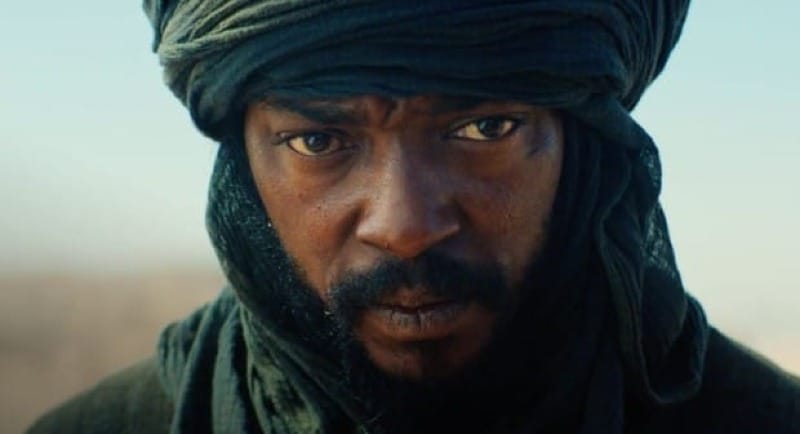
Because this was just a bad deal from the start. Mackie's character, doing his best Man-Without-A-Name Mad Max ronin guy, is only known as the "mysterious and unnamed" bandit. This is a very clearly a tacked-on afterthought of a character that is shoved in amongst all the historical names. In these situations, filmmakers will usually say something like, "well, a guy like this could've existed." That's what they are doing here, because they needed to squeeze in their much-needed star, as they otherwise didn’t actually have a place for him in the story. So I while I understand the reasoning behing his insert, the thing is, after having watched the film, he still doesn't have a place in the story. The bandit so needless a character, that if you just digitally removed him from the film, I don't think it'd be all that noticeable. Like, if I didn't know better, I'd suspect that they shot the complete movie, and then, at the eleventh hour, were told they had to include Mackie, but didn't have time for more than maybe a day or two to shoot some quickly-written additional schemes, so they finally just green-screened him into the rest of the movie, just kind of standind off to one side and occasionally going "Yeah! I agree!" or something.
I wonder if this was the decision that was forced on Rupert Wyatt. Was Anthony Mackie's inclusion the “creative difference” that caused him to briefly quit?
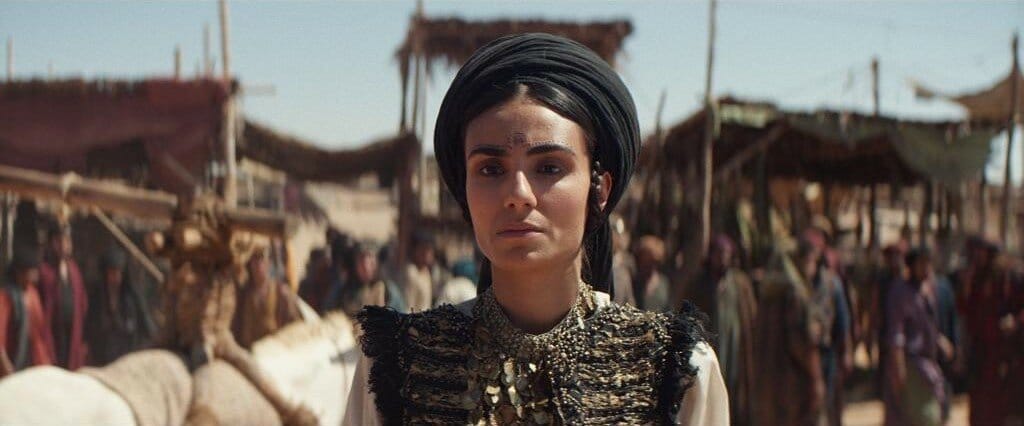
Because this is obviously supposed to be the story of Princess Hind, the character who unites the tribes and leads them into a battle.
Hind bint al-Khuss al-Iyadiyya is a possibly real historical figure, who might have been a pre-Islamic Arab poet, who may have descended from the djinn, who may have had blue eyes that could not only be able see riders approaching a week away, but who could also see into the future, and who may have loved a Christian woman named Hind bint al-Nuʿman, and that when Hind bint al-Khuss al-Iyadiyya finally died, al-Nu'man is said to have hacked off all her hair, swore to God to never again wear anything but black, to forver reject all worldly pleasures, and to never love another, and then she built a monestary in her name.
Or... to be fair, she may not have existed at all. Either way, she's more interesting than the mysterious and unnamed bandit.
This film also stars Sharlto Copley, who was once almost a thing, but now mostly slums it in shit action movies, having at some point morphed into a tough guy. He is part of what might be the film's only half-way interesting choice, and that was to make the emporer's gang of mercenaries into a kind of Legion of Doom meets the Varangian Guard, which was an elite unit of the Byzantine army from the 10th to the 14th century, who served as personal bodyguards to the Byzantine emperors, and were primarily composed of foreign recruits, mainly Viking marauders and Anglo-Saxons from the British Isles.
This is yet another reason why Constantinople may have the coolest place in the entire ancient world. That there was a Scotsman engineer and artillerist named John Grant, under the command of a Genoese nobleman and mercenary captain, named Giovanni Giustiniani, defending the walls during the Fall of Constantinople is a detail I just love. The idea that there were viking warriors walking those city streets too, is the kind of historical fact that really blows up the argument every time some racist gets mad that there's a black person in a fantasy movie.
But I digress...
Anyway, in the film, these mercenaries also give off the very familiar vibe of modern day American ex-military who now work as Private Military Contractors. They're a small but ruthless team of obviously battle-scarred veterans from around the world, each one presented as their own distinct villain, each clad in a variation of the basic group uniform, each one carrying their choice of weapon the way they prefer to carry it. They're like evil G.I. Joe, but in the ancient world. If this film had been set in the modern day, they would've all had call signs like: Spector, Gibbons, Ho-Jin, Frost, Andretti, and Billy “Big Bear” Barbarossa. They all ultimately turned out to mean nothing, but for a second, this was a potentially interesting choice.
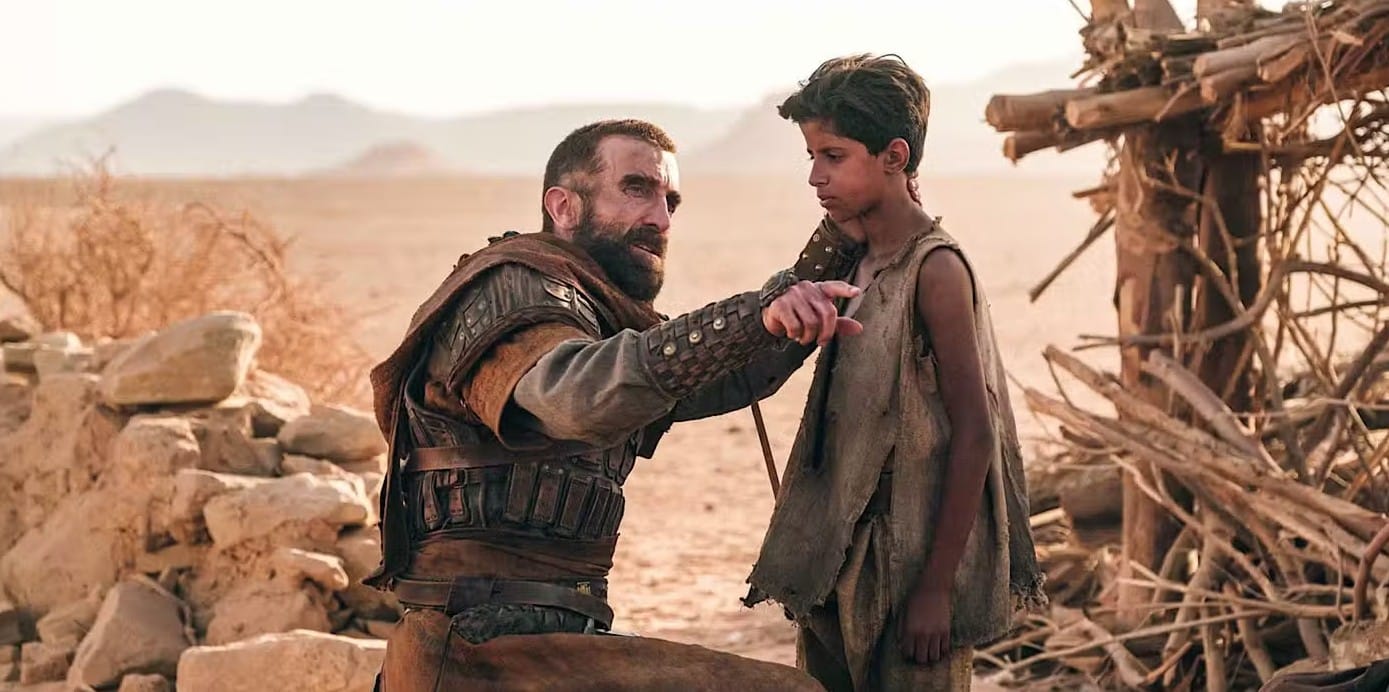
Desert Warrior is a classic kind of adventure film, or at least an attempt at one, and it's filled with big sweeping vistas that look great. But as you watch it, you can’t help but think that, when they used to make these kinds of pictures, the hero could either do the stunt-riding themselves, or the director understond that they at least needed to get in tight and make it seem like they could.
That's not the case here.
Instead, this film is just too self-assured that its events are emotionally moving and/or inspiring, that they have a weight to them that the film never even comes close to earning, and that's a big part of the problem. This is a film that thinks it's Braveheart, when it's actually just the Mummy, but without the fun bits. It really should have been focused more on making the fights look cool, and on making the chases on horseback fun, because Desert Warrior has got nothing as far as a deep and meaningful story is concerned, but that said, at times, it can be pretty decent when it comes to action.
Is this why it flopped? Partially. You could say, “oh, the lack of marketing is why this film did so poorly,” and you wouldn’t be wrong there either, but regardless, in the end, this is just a bad movie. That's it. This is a film so deeply and undeservedly trusting in its epic scope and soul-stirring inspirational events, that it completely fails to deliver on anything cool or memorable or worth paying to see. It's not just terrible, it's dull.
Big time thumbs down. Hard pass.