Nobody 2
“Plummerville just isn’t as friendly as I remember it to be.”

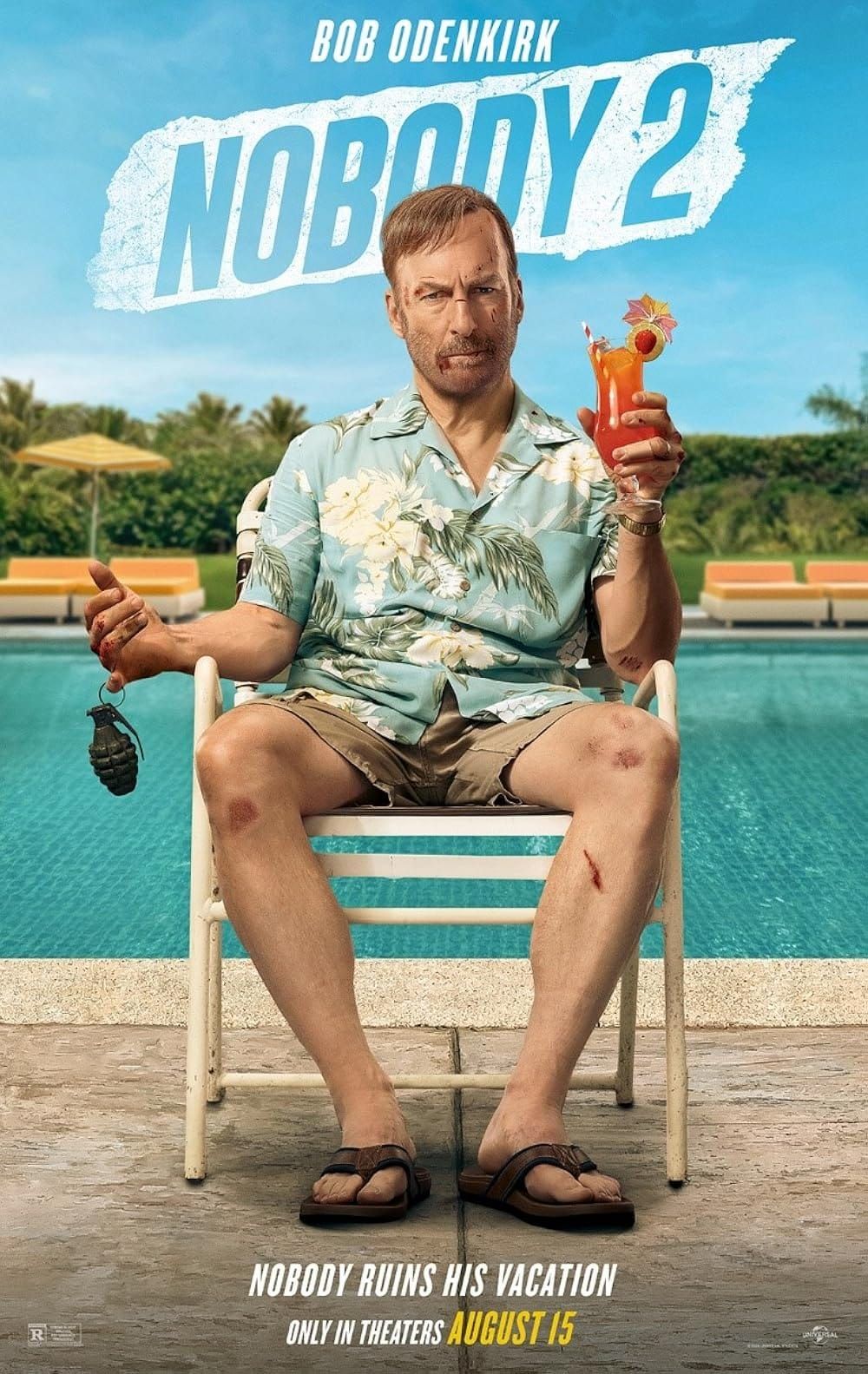
Hutch Mansell's family vacation is disrupted by a gang of criminals, forcing him to use his lethal skills to protect his family.
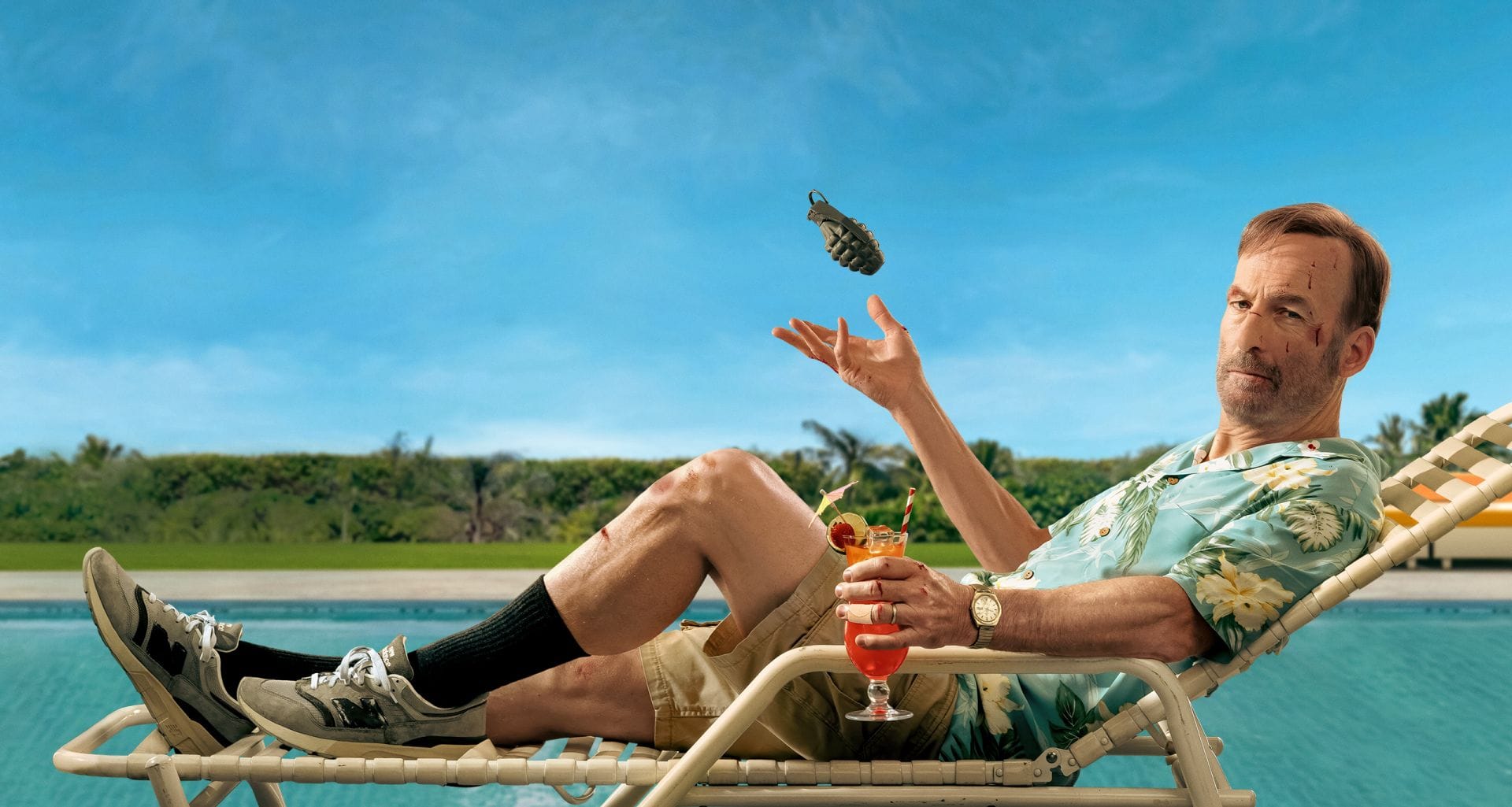
Starring the always great Bob Odenkirk–who has been in way too many amazing things to list, including Mr. Show with Bob and David, Breaking Bad, one episode of The Office, and Better Call Saul, which is one of the best tv shows ever–directed by Timo Tjahjanto, who directed the incredible The Night Comes For Us, and the less incredible The Big 4, and written by Aaron Rabin, who wrote some of the Jack Ryan tv show, and Derek Kolstad, the creator behind the incredibly successful and iconic John Wick franchise, Nobody 2 definitely has a nice pedigree behind it, and the potential to be really entertaining. Especially since it’s fair to say that Derek Kolstad is a pretty big gun in Hollywood.
Unfortunately, it’s a gun with just one bullet, so…
Here we are with yet another take on the John Wick “you pissed off the wrong super assassin” formula, but this time, instead of a slim and taciturn dark specter of a death in a sharp suit, the Nobody franchise puts a “schlubby, exhausted Little League dad” into its super-assassin role. It’s been awhile since I saw the first film, but the main thing I remember is I was totally in from the start, especially during the bus fight scene, but by the time the schlubby secret super assassin and his dad and brother had gathered together for the big climatic end fight against the bad guys army of gangster Redshirts, I was pretty bored and checked out…
And now here we are with Part 2!
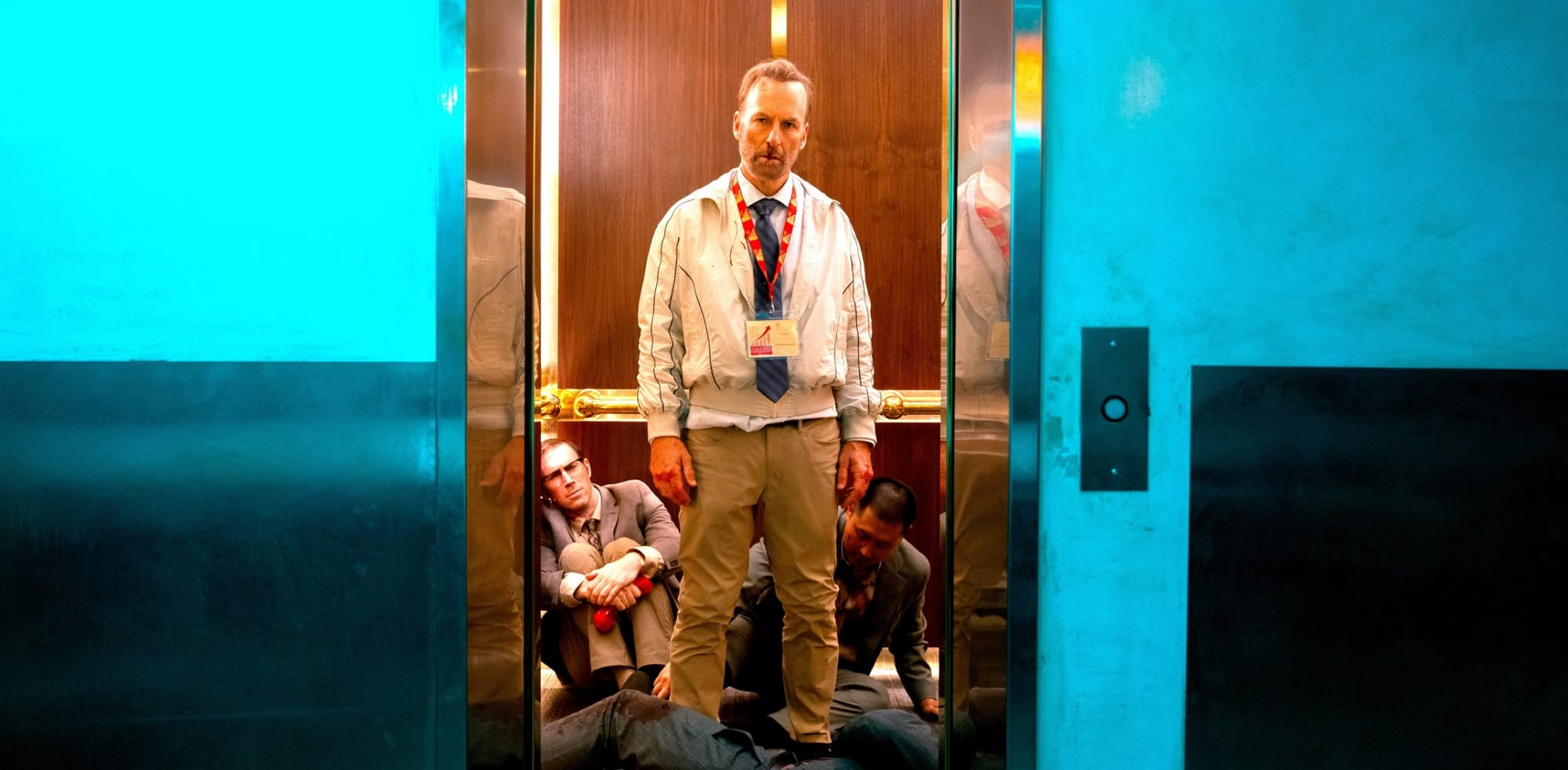
After the events of the first movie, in which Hutch Mansell, a former high-level assassin for the U.S. government who had been living a quiet suburban life until a chance home invasion sets off a chain of events that results in him killing an entire Russian mob family, and in the process, setting fire to a Russian mob obshchak—a centralized pool of money used to settle disputes within the Russian mafia—Hutch is now deeply in debt “The Barber,” his former government handler turned Fixer. The Barber paid off Hutch’s debt to the Russian mob, both for the damage and the destroyed money, solving that particular issue, but Hutch is in debt to The Barber, who now sends Hutch on murder-assignments in order for Hutch to pay off that very sizable debt.
As a result, Hutch is working all the time, and missing so many important family events, big and small. The bridges that Hutch had previously mended with his wife and kids, due to them having all bonded during his mass murder spree of Russian mobsters, is fraying once again. Plus, Hutch is exhausted.
He needs a vacation, a family vacation.
So, after discovering an old bumper sticker underneath one of the guys he recently killed, Hutch is inspired to take the family to a shitty waterpark “family fun zone” in the upper Midwest. The place is clearly based on the Wisconsin Dells, but in the film, it’s called Plummerville, probably due to the generally unflattering, but 100% accurate portrayal of that fetid and gaudy Trash Palace of Americana. Still, Hutch is excited to go, because as it turns out, his dad once took him there as a child, so why not inflict that trauma on the next generation, right? Why not add some foot fungus to your pile of problems, heap it on there with marital strife, with failing to connect to your kids, with having to deal with other people and their ugly children, and the stuffy and foul-smelling cross-country trip in a full minivan in order to get there, not to mention the bed bugs, the black mold, and the salmonella that comes free with every motel room, after you've arrived.
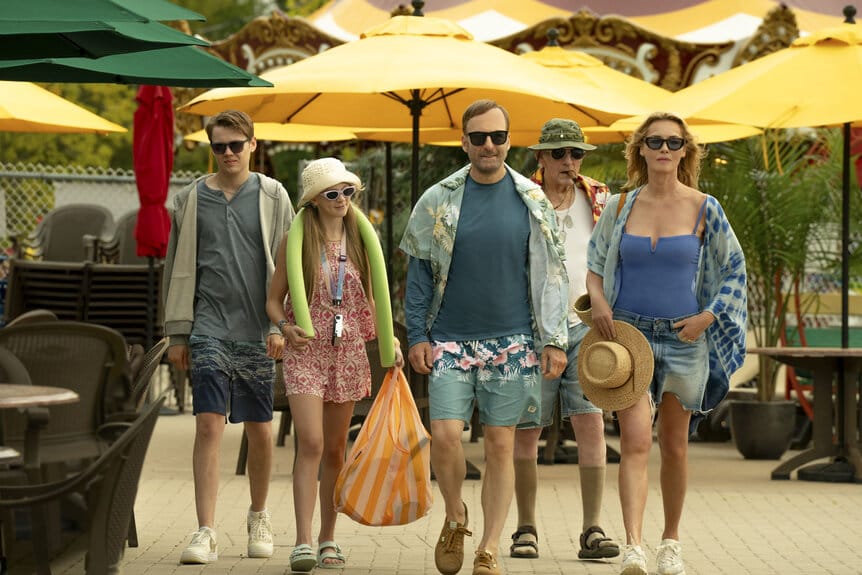
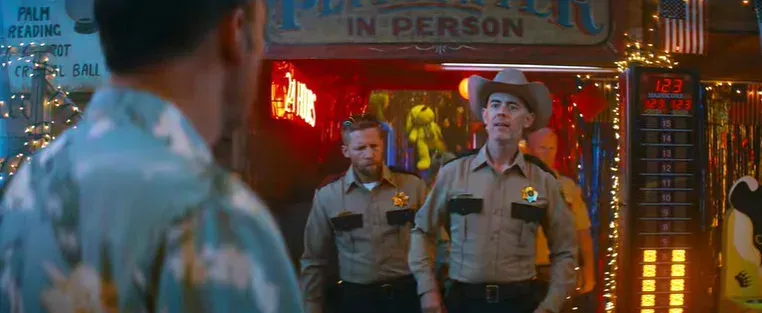
Unfortunately, the water park turns out to be full of bad guys who need killing too, because of course it is. The first hint being local law enforcement, the typical dead-end townie piece of trash who has become the tiny little king of his tiny little turd mountain, in stupid fucking cowboy hat, and acting the ass in the face of our hero, as it’s a fresh chance for him to flex his undeserved control of the life and death of everyone around him. This is, of course, a feature of American society, not a bug, and is otherwise known as “One Of Our Biggest Problems.”
Soon enough, the white trash is crawling out the woodwork and picking trouble with the “City Folk,” because when white America can’t harass and kill any POC, or anyone from the GLBTQIA+ community, or any immigrants, they have to turn on each other, because where else are they gonna put all that hate. And if there’s no obvious Irish or Italians or Catholics around for them to suddenly decide aren’t the right kind of white or Christian anymore, that leaves them with no other choice but to turn on any “outsiders" who happen to be present.
Unfortunately for the family vacation’s good vibes, Hutch is also a suburban white male in America, so he is seething inside, a barely contained ball of rage born from the general dissatisfied malaise of mediocre white privilege, so he goes ham on one of the groups of local asshole townie trash giving them the stink-eye. This upsets the previously mentioned dead-end townie trash who managed to become sheriff, as he feels that he, as a piece of dead-end townie trash with a badge, isn’t being given the respect that he deserves from these “City Folk.”
So, as cops are wont to do, he decides to fuck them up...
This sets off a chain of events that culminates in a gunfight at the local rundown, fungus-riddled water park. Joining Hutch is his former FBI agent father, David (who is played by the always welcome Christopher Lloyd), Harry, Hutch’s Black ninja adopted younger brother (played by Wu-Tang’s RZA, who proves that he is indeed nothing to fuck with), and Wyatt, the local corrupt theme park operator, a dad himself, who defects to Hutch’s side after they bond because Hutch saved his kid from gangsters. Kids, amirite? The group then does an A-Team-like montage of setting various boobytraps around the waterpark, using grenades, land mines, C-4, tripwires, sharp sticks, and a Gatling gun.
During this very American brouhaha in this very American setting, Hutch and his wife Becca find their love once again by killing bad guys together. Meanwhile, his son finally learns what it means to be a man by merely choking out the mercenary who came to murder him, his sister, and also Wyatt’s son, instead of just killing the masked goon. And if there’s a better example of living the Word of the Lord than that, I don’t know it. After all, as we all know, Matthew 5:7 (NIV) says: "Blessed are the merciful, for they shall receive mercy."
Truer words, amirite?
Anyway, in the end, there’s a pile of bodies scattered amongst the wreckage of the water park, as well as their family vacation, and all of the explosions have alerted the cops and the FBI, who then show up, and are all probably pretty upset that all this murder happened and they didn't get the chance to participate. Luckily for our heroes, before the cops can start taking their Thin Blue Line murder-blue-balls out on Hutch and his family, they get an important phone call. Moments later, Hutch and his family walk free, free to return to their Pleasant Valley Sunday life of nice suburban mediocrity, generally unburdened by the blood that is now coating all of their hands, and fulfilling the general over-arching metaphor of the film... “membership has its privileges.”
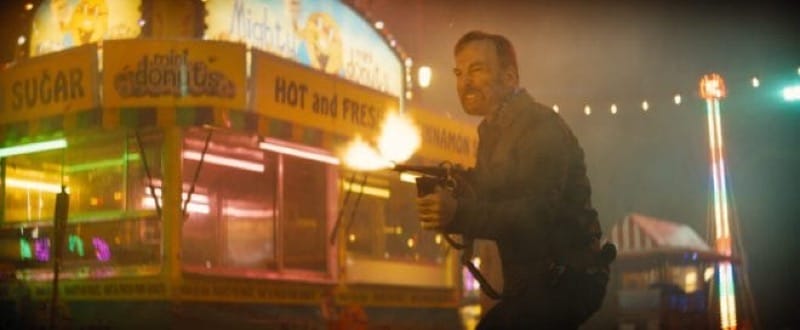
On one hand, Nobody 2 is a really great film if what you want to see is a bunch of white red state Middle-American assholes very elaborately getting the absolute fuck kicked out of them.
So there’s that at least.
But other than that… meh, as Nobody 2 is mostly just an uninspired retread of the events of the first film, which was just an only kind of inspired retread of the John Wick premise, but this time minus the kitschy novelty of seeing Bob Odenkirk do a bunch of Van Damme-age on a roomful of bad guys. And honestly, despite having Timo Tjahjanto at the helm, even the Van Damme-age here seems a bit too rote and restrained. It all feels like the same "beats" over and over and over again.
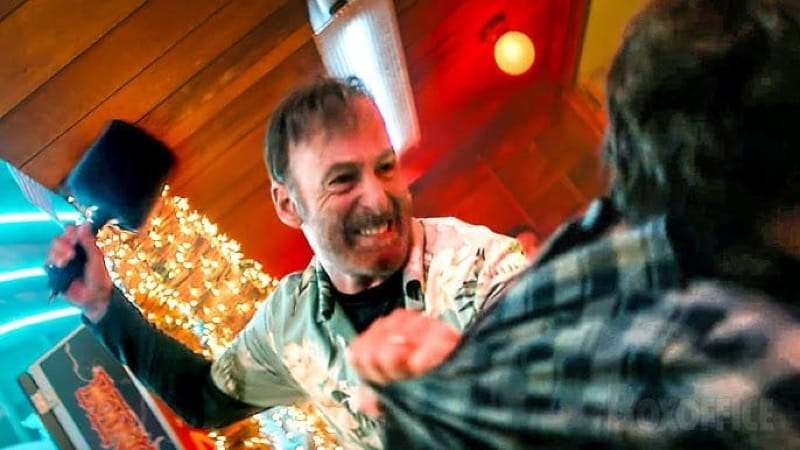
One thing the film does get right is by showcasing, both directly and indirectly, how, if you’re not one of them, it’s best to stay out of white small town/suburban areas anymore, especially in the hinterlands of America. There’s nothing there now but trash and assholes and the need for either a rabies or a tetanus shot. With this clear-eyed presentation of the setting, the film clearly highlights the slow wheezing death of the American dream, exposing the chipped paint, burnt-out light bulbs of the gaudy cheap facade plastered over the rabid toxicity of a stagnant culture long gone to festering rot.
“Plummerville just isn’t as friendly as I remember it to be.”
This is a lament voiced by our hero at one point in the film. It is, whether deliberately or not, a perfect encapsulation of what it’s like to return to these places we once grew up in, naively believing that your memory of it is a true one, and not one tainted by privilege and the naivety of youth, only to then be forced by ugly reality to see otherwise. The film does a decent job of illustrating this when Hutch finds himself faced with the choice of either walking away clean, free to go live a nice, happy, and unconcerned life, but only if he’s willing to abandon another to a fate of pain, torture, and death, or… to do something about it. When this situation is viewed through the lens of being a metaphor for the world some of us now live in as white Americans, where the only two options you have is to either wrap yourself in your privilege and blithely ignore the bad people we thought we once knew, and the bad shit that they do, or accept that you can simply never go home again, that part at least, is pretty well done. Especially seeing as, for Hutch, it’s clearly no choice at all.
Another thing the film does pretty well is how the whole problem stems from nothing else than the fact that one fuckhead white guy, some dipshit loser dead-end townie fuck, a cop, who just can’t not be a dick. This worthless asshole decides that he has been slighted somehow and that’s it, now it’s a never-ending problem until everyone’s good time is completely and irrevocably ruined. This, of course, is also a well-done metaphor, specifically about how the majority of white Americans voted Trump in the last three elections, mostly due to their aggrieved racism and a not inconsiderable amount of residual anger over the self-perceived slight because their feelings and wants weren't appropriately prioritized by everyone else, as they believe they should be, so as a result, they decided to fly the plane straight into the mountain in a big bigot temper tantrum. We could've just gone on, left each other alone and lived our lives, but white America simply would not allow that. No, sir. And that's what the film does a good job of showing, as Hutch wasn't there for wetwork, he was there to get wet, and have a good time with the family, but the cop decided that Hutch looked at him wrong, so everything ended in blood and fire. What's the quote from Cool Hand Luke?
"What we've got here is... failure to communicate. Some men you just can't reach. So you get what we had here last week, which is the way he wants it... well, he gets it. I don't like it any more than you men."
That's the whole of it right there. That's America under white supremacy.
This metaphor works especially well when you draw it all the way out to the end of the film. It's an ending where all those dumb shits end up dead, and it is solely as a result of the actions that they themselves chose, and allowed to ve chosen for them, and all out of an insatible sense of entitlement and a love of being cruel. This is the way they wanted it, well... they got it. This also means, of course, that they fucking deserved everything they got.
Now, were these metaphors intended?
Uh…. y’know, I’m not sure whether or not I‘m willing to say yes or no. I mean, to be fair, you could maybe also make the case that Nobody 2 is actually a defense of the Karen Mindset, a metaphor for how, when your needs and expectations are not met exactly as you expected, because you are The Customer, then you are justified to go on the fucking warpath, consequences be damned!
...Either way, this at least made this film a somewhat satisfying watch for me, even if it ultimately ended up being a somewhat dull one too.
Nobody 2 is the type of film where characters will fire a weapon dry and then toss it aside like it’s an empty juice box. A film where, instead of carrying more bullets, they just carry a ton of guns. It's the kind of film where there’s also an obligatory appearance by The Storm on the Sea of Galilee by Rembrandt. This painting was famously stolen during the heist at the Gardner Museum in Boston in 1990, and it‘s never been recovered. It’s perhaps the most well-known piece of art to ever be stolen, and as a result, it has since become a common bit of cinematic shorthand for “wow, look how well-connected these criminals are.” So, you see that here. It’s the kind of film where a Murder Machine walks into a bad guy hideout, and starts killing dudes left and right, and somehow, even after the first dozen or so guys are all killed in a variety of ways, there’s still more guys to kill. How? How much are these guys getting paid that they will watch multiple men, people they work with every single day, get killed off one by one, each one of them in some frighteningly unusual and clearly painful way, and all by various items lying around the hideout, and yet, they are still somehow willing to rush in to the fight? Especially when the main bad guy isn’t a boss who believes in positive reinforcement, like say… Hank Scorpio does, and instead just kills you if you screw-up? The loyalty goes beyond impressive and into dumbfounding. Also, the main bad guy is Sharon Stone, which I did not even realize until just now, and Nobody 2 is the kind of film where they have her use the word “zealot” in a way that feels like it’s not quite the right way, and I couldn’t tell if that was due to the writer's mistake, or if it was intended to say something about the villain…
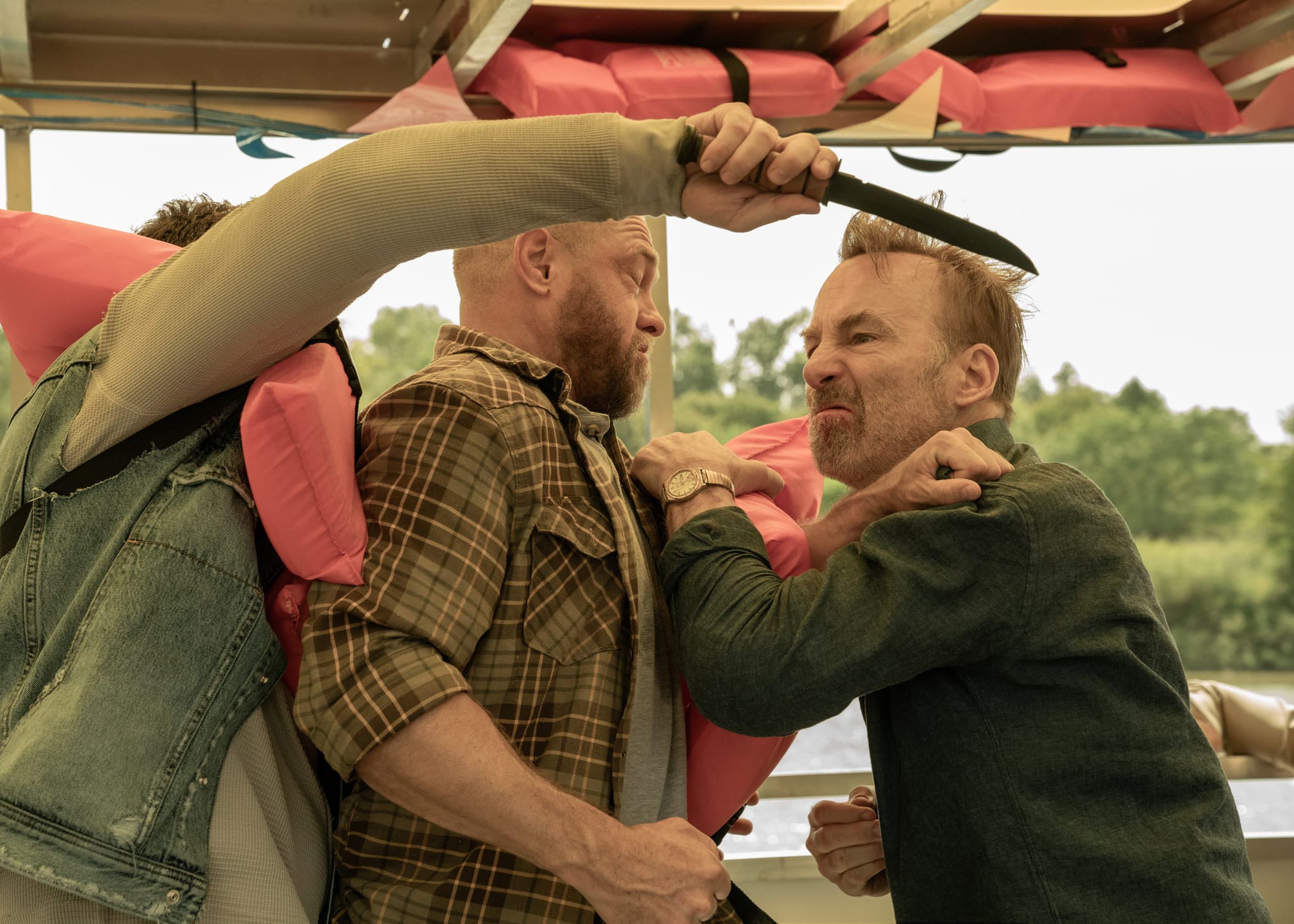
Also, the general question of “believability” bothered me throughout. Yes, yes, “believability” is a ludicrous thing to consider with one these stories, which take place in a world where gun fights and martial arts brawls break out everywhere, so yeah, the idea of believability is a silly one. But at the same time, there’s something about Hutch’s world that just seems so much less “believable” than John Wick’s does. Maybe it’s the Kmart fashion and minivan lifestyle, maybe it's that it happens cheek to jowl among so many soccer moms and Home Depot dads, maybe it’s just Bob Odenkirk himself, but it just seems too loud. There’s too much blood amongst too many Karens, too many very dead big fish in an otherwise very tiny little pond. Like, I just don’t believe you could have a five guy brawl on the back of a pontoon boat without the people in the front of the pontoon boat noticing, even if they do have headphones on. It's not the big! The boat would rock wildly! I also 100% do not believe that a pontoon boat tour would allow guests to decide for themselves that they’re just not going to wear a life vest. Insurance costs supersede butthurt complaints by asshole costumers.
Whatever. It's a Bob Odenkirk doing a Kmart John Wick.
In the end, I feel like this film should have leaned harder on the wacky National Lampoon’s Vacation feel, and really let Bob Odenkirk do a Clark Griswold kind of thing, while also doing the John Wick thing, but alas… So, all we’re left with are some terrible kill-puns, and that weird feeling that you're watching an attempt to find the movie in post that didn’t quite work out. But, hey, there were a couple of fun “kills” at least, so there’s that.
Thumb’s down.