The Long Walk
It goes on...


In an alternate America, fifty young men walk across the Midwest in a televised contest. If they stop walking, if they slow down, they are executed. The last young man still walking will win a fortune, as well as their deepest wish.

Set in a dystopian "alternate" version of the United States, one that is ruled by a totalitarian regime, the plot follows the contestants of a grueling annual walking contest. It was published in 1979, under his pseudonym Richard Bachman.
While The Long Walk is not Stephen King's first novel to be published, it is the first novel that he actually wrote. He started this story in his freshman year at the University of Maine in 1966-67, which was about eight years before Carrie, which was his first published novel, was put out in 1974.

The Long Walk was eventually published in 1979. Considered to be one of King's most pessimistic and bleakest story, not to mention a very dark mirror of modern day America, and due to the inclusion of things like the televised draft, the sudden horror of seeing new friends die, and the seeming lack of reason for why the Walk was actually happening, amongst other things, clearly indicating that it was meant to be King's young attempt at a metaphor for the Vietnam War, The Long Walk was received with little fanfare at the time.
Then, in 1985, it was collected in an omnibus called The Bachman Books, along with three other novels, Rage, Roadwork, and The Running Man, and as a result, gained more attention, as the general tone of all four novels appealed to those who were looking for King's "darker" horror work.
The Long Walk is actually the second of the Bachman Books to be adapted. The first being the original Arnold Schwarzeneggar version of The Running Man, which is a stone cold classic, and was recently rebooted. However, The Running Man (2025) by Edgar Wright, while an attempt to be a much more faithful adaptation to the original story than the previous version, it is still a pale shadow of that film. And on top of that, it was flat out terrible.
Unfortunately, much like the most recent version of The Running Man, The Long Walk is also an attempt to be a faithful adaptaion of the original story.
It is also terrible.

So, the film begins...
Dear Mr. Raymond Garraty,
Congratulations!
Your voluntary submission to participate in the Long Walk has been accepted through lottery. You now have the rare honor of representing your state as a symbol of hope in these economically desperate times. The entire nation will be watching the live broadcast with admiration and awe. If you win, unimaginable riches and a single wish await - a chance to break free from today’s financial struggles and inspire the nation. Please report to the starting line in May 1st by 8:00 am.
Luck to you, Mr. Garraty.

In an "alternate" 20th century, twenty years after a seemingly white Christian authoritarian regime has taken over the United States, after a second Civil War, there is an annual national event known as the "Long Walk." This event is meant to inspire patriotism and a strong work ethic among the young and the destitute, as the country is now wallowing in a severe economic depression.
So, every year, fifty teenage boys, one from each state, are chosen randomly. Paticipation is voluntary, but most eligible young men sign up every year in the hope of improving their families' lives. Those who are chosen are then given water and rations, and then they must walk hundreds of miles nonstop, all while escorted by armed soldiers. While walking, they must maintain a pace of 3 miles an hour. If they stop, or if they fall below that pace, they will receive a total of three warnings. On the fouth warning, they are executed. The Walk ends when only one survivor remains. The winner receives a large cash prize, and the promise that they can have one wish fulfilled.
The event is broadcast to the entire nation.
It's basically this world's Superbowl.
Ray Garraty is this year's participant from the state of Maine. His mother Ginnie drives him to the starting line, where she breaks down and begs him to back out, but he refuses. Among the other boys waiting at the starting line, Ray meets Peter "Pete" McVries, Billy Stebbins, Arthur "Art" Baker, Collie Parker, Gary Barkovitch, Hank Olson, and Richard Harkness. The boys all chat and bond and puff out their chests and measure their dicks, and through this brief interaction they indicate to the audience what their particular roll in the story to come will be... The Good Guy, The Best Friend, The Asshole, The Fool, The Monster, The Dummy, The Doomed One, The Rebel, The Other Doomed One, The Weak One, The One That's Going To Be The First To Die Because He's A Naive Dipshit.
And then there's the Major, the regime's mysterious and near-mythic posterboy. He oversees The Walk participants, as well as its attendant death squad. Before the event starts, he stands on the back of an Army Jeep and trumpets some obviously fascist "patriotic" blather, and then finally...
The Walk begins.

Walk and Talk. Walk and Talk.
But these Walk and Talks are not like the ones during the West Wing, where it was all rapid-fire banter through the halls of a fantasy world White House. No, this is a much slower and unfunny version, just a bunch of boys as they shoot the shit and talk smack and growl at each other, and then, every once in awhile, one gets shot in the head, sometimes while they're crying, sometimes while they're delusional, and sometimes while they're covered in their own shit. It's not badly done at all, but it kind of goes a certain way in a certain pattern.
They're introduced. They make their character statement. They fall in various ways. Sometimes they fight. Sometimes they trip. Sometimes they can't keep up as the group climbs a steep hill. Sometimes they get a charley horse. Sometimes they break an ankle. Some of them give up at weird moments for weird reasons. It's a litany of different issues that all end the same.
One by one, they get shot in the head.

Wash, rinse, repeat.
Mostly, the boys talk about why they signed up.
It's mostly talk about wanting to be wealthy, or wanting to help their family or other people. One kid plans to wish for naked ladies. One kid wants to be a writer. It's very much like a bunch of young dumb soldiers on their way to their first unit, but instead, they are walking through a 1970s "Grapes of Wrath" midwest-like, or maybe Appalachian, section of America... which means it was filmed in Manitoba.
Finally, it's down to the last two contestants, and it's exactly who you'd expect them to be, as the story heads into an ending that feels like it was chosen because of potentially one of two reasons.
- The ending from the original story was too "dark" for the suburban dipshits who generally makes up your average Burbank Test Audience, so the studio changed it.
- The ending from the original story is the definition of anti-climatic/unfilmable, so the filmmakers changed it. Plus, the new ending came with the added bonus that it was the option that will both "surprise" those who have read the original story, while also being the one that general audience will expect slightly less.
Either way, this change was clearly done without any concern for how that changes the story's metaphor, or what this new ending actually ends up saying.

So, yeah, I was not a fan of this film.
Much like the film's central event, it felt like it just went on and on and on. And that's not to say that it wasn't an faitful adaptation of the book, which I enjoyed as a kid. It was. But, honestly, I think that's the problem. Much like recent attempt at a faithful adaptation of The Running Man, the fact is... The Long Walk just doesn't lend itself to a being good movie. That's fine. Some Stephen King stories are like that. Sometimes his stories are much more concerned with internal action/terror than they are with external action/terror, and that can be hard to properly convey in a film. And unfortunately, even though this story is centered on a very external action and terror, a literal death march, it's actually more of an internal story, as it is a metaphor about a young man struggling with the horrors of war. Even worse news for the film, since that is a metaphor, and the story isn't actually about a war, you don't even get to rely on the occasional combat scene to wake up the audience.
Nope, it's just walking.
And the occasional gun shot.
So as I mentioned, to combat this undeniable fact, the film has tried to make changes from the novel in several ways, some big, some little. The walking pace was dropped from four miles to three to make it seem more realistic, even though by the end of the film, the idea that they've walked 350 miles without a nap pretty much sinks that whole idea. They also changed the total number of particpants from 100 to 50, just one contestant from each state, which makes sense, and they have merged some of the characters into others. These were both an obvious effort to speed things up. An effort that, to me at least, seemed to be a failure, as despite it's hour and forty-eight minute runtime, the whole thing dragged.
The film also removed Ray and Pete's exploration of what was at least their bisexuality, if not homosexuality, opting instead for their relationship to just be two good buddies. Just two strangers who met in a foxhole and instantly decided that they liked each other very very much, but not like like, y'know? These are just two good buddies. Two good buddies who like boobies. Nothing but buddies. Also, just fyi, I probably shouldn't have said "but buddies" there. That sounds too much like "butt buddies" and I don't want to muddy the waters here, as that is totally not what's happening on screen. They're just friends here. Friends who care about each other in strictly manly ways. We don't want to upset the bros in the audience, all those guys who decided to go to a movie together, but sit with one open seat between them, just so that everyone is aware that this is not a date.
That said, I also want to make clear that, if the filmmakers were trying to take all the gay out of this film...
They missed some.
Anyway...
Most importantly, the whole "revenge on the Major" ending is the type of change that was clearly added in an obvious attempt to give the film some kind of tangible resolution, but all it ends up doing is trampling on the story's attempt to finish up this war metaphor by saying something about PTSD, and how the horror of war goes on, and how even those who survive and come back physically whole can still be damaged. With its new ending, the filmmakers apparently decided to go with a new message that basically says, if a white person doesn't get to see their dreams realized, people of color should throw away their own dreams, and make sure that the white guy's dreams are fulfilled, even if doing so destroys them in the process.
So, yeah... thumbs down from me on that.

Living in trump's Amerikkka means that this doesn't shock me.
What did shock me was the amount of people–many of whom watch and review movies regularly–who were dumbfounded by this film. Flabbergasted. Most were openly confused by the "sparseness" of this film's world-building. They all claimed that they didn't have enough information about the world to understand the story's context. I've never seen so many people demanding to be spoon-fed by such an easy-reader story in my life. I was shocked.
And the way that they all seemed to take this film at face value too?
Staggering. I was staggered.
I saw multiple people acting like they were being so fucking insightful and saying shit like... "How exactly is the Long Walk supposed to help the American economy in this film? What do the American people find to be hopeful about this? I don't get it!" It's amazing to me, that in a world that (very undeservedly) went ga-ga nuts for the Hunger Games, people would not be able to understand what this world's deal is, or why they would hold an event like this, or what it is actually supposed to say to the populace.
How the fuck can these assholes live in Trump's facist white Christian America and not just assume that the government in this story is lying to the people? How can a person be so obtuse, so incurious, so unwilling to engage even a tiny little bit with the art that they deliberately paid to see? I really dislike being presented with yet another painful microcosm illustrating the reasons for the downfall of America.
ugh.
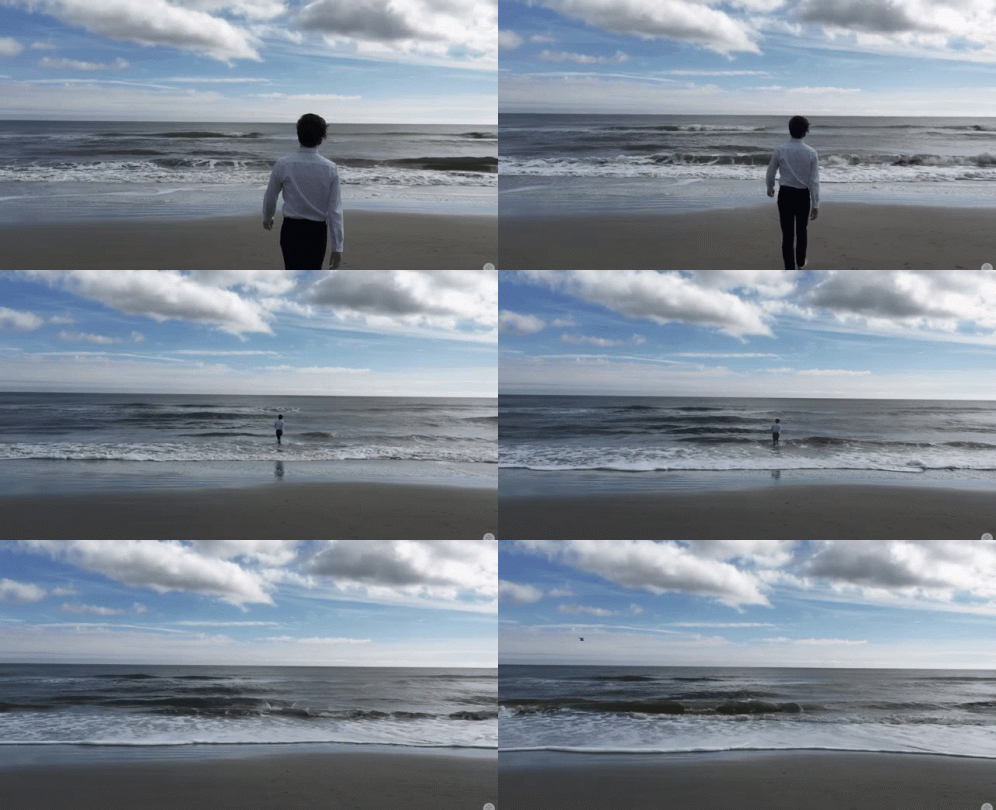
Myself, living as I do in a world where media literacy is almost nonexistent, and Trump’s hubris, greed, bigotry, and stupidity has led him to plunging us into a war he lost almost immediately, and achieved nothing but to choke off our oil; living as I do in a world where Trump–with the open support of the overwhelming majority of white Americans, across all demographics, who voted for him three times–has trampled our rights, sent masked Gestapo to murder people in the streets, and has destroyed not just the agriculture markets, but the justice system, public health, government services, our social safety nets, our scientific research communities, our national monuments, our institutions, even our national celebrations, literally everything that he has fucking touched... the broken-down America that this movie is set in, with its ignorant populace volunteering to kill themselves for a long dead and unachievable dream, I actually found all of that, the worldbuilding, to be very believable, and very easy to understand. Every part of it.
Honestly, the only unbelievable part is that all 50 states still exist.
Okay, sure, fine... I'll allow that maybe the Vietnam War metaphor might be a little outdated at this point, right? It was over 50 years ago. Fine, then... pick one of our more current forever wars to substitute in.
Regardless, the obvious fill-in metaphor here is that capitalism and religion are nothing but lies meant to trap you in their bullshit. Neither one cares about you, and the only thing they offer is to grind you down. It doesn't matter how long you last, what you believe in, or what you're trying to accomplish either, if you play the game, sooner or later, it'll grind you down too. Say this for The Long Walk, it really is the perfect metaphor for America, the inanity, the ugliness, the stupidity, and the futility. It's just too bad the movie wasn't very good. That said, the brutal gore is effective at least. The sound mix on the gunshot was well done too. It was nice and loud, to make you jump.
But seriously... is it even possible to walk 350 miles without a single nap?
Mostly, this film reminded me of the experience of watching It (2017) and It Chapter Two (2019), another King tale that has been adapted and re-adapted to varying levels of success. With the latest It movies, afterwards, it was clear to me that the filmmakers were very familiar with the story, and had probably even read it multiple times, and yet, it was just as clear to me that they didn't understand that story at all. That's the feeling that I got from watching The Long Walk, with the adaptation choices they made. I feel like the filmmakers are very familiar with this story, but I also feel like they either didn't understand what it was trying to say, or they didn't care. That said, unlike the It movies, I don't think that this is the main reason why this film is bad though. I think the main problem is that the story of The Long Walk simply doesn't work as a film , or at least not as a horror-lite film that is meant for a mainstream pop culture audience to consume. In the end, this is a film where nothing worked, at least for me. But to be fair, lots of people seemed to like it, so maybe your mileage will vary.
But I was not a fan.