It Ends
“Life is a highway! I’m gonna drive it all night long!”

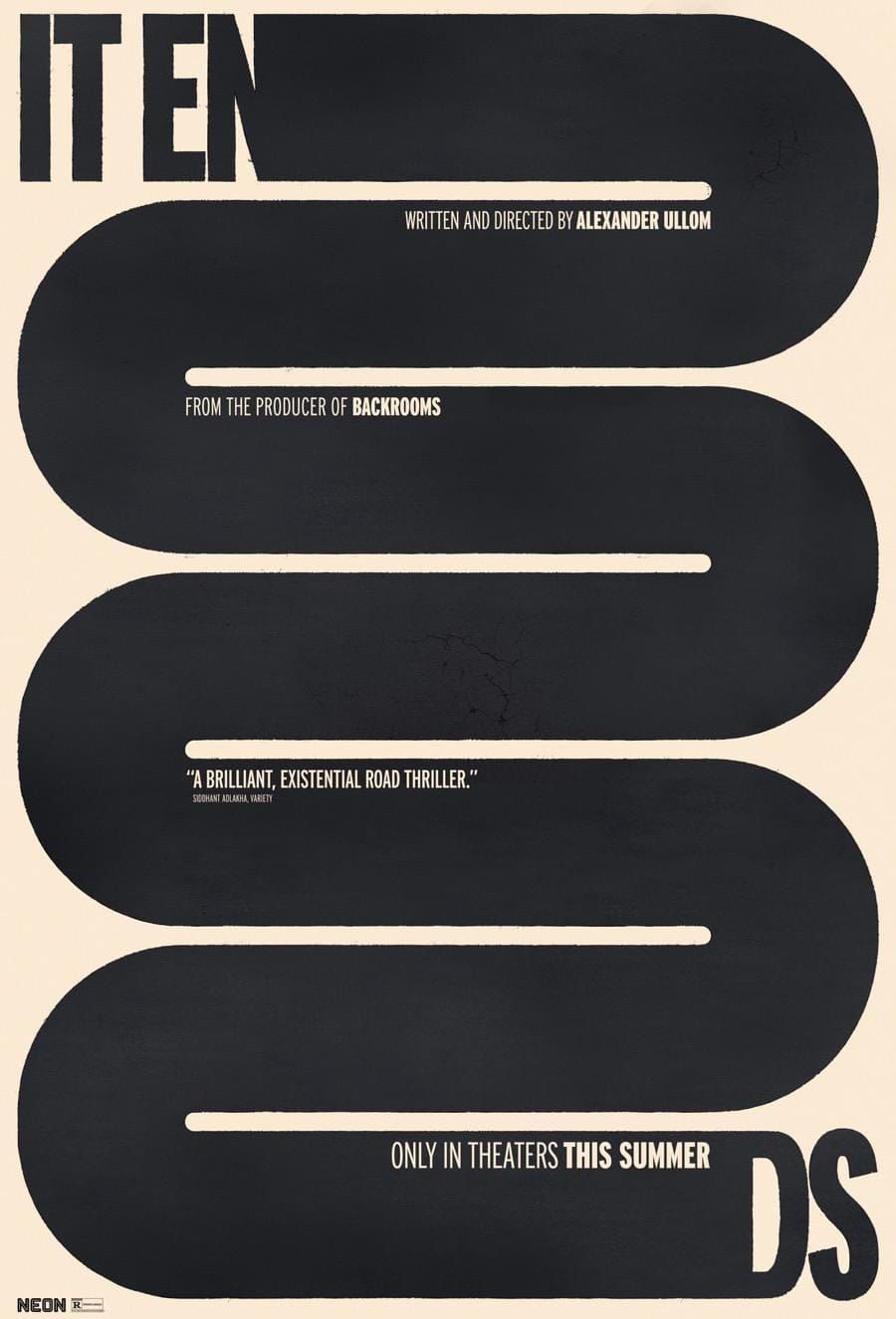
Suddenly finding themselves stuck on a seemingly never-ending road, four friends struggle to accept their new reality of endlessly driving, all the while plagued by the question of just how long will they be able to go on...
It Ends is the directorial, writing, and editing debut of Alexander Ullom.
According to internet legend, after experiencing a mental health crisis ten years ago at the age of 18, Alexander Ullom switched from his previously-decided shitty corporate-office/compute-related career path to becoming a filmmaker—after first pitching the idea to his wary parents via a PowerPoint presentation (most likely for funding)—and moved from Florida to Los Angeles.
Much like the Kevin Smith of old, Ullom and his friends worked together on the margins of their part-time job lives to get It Ends off the ground. The film‘s initial budget of $30,000 was largely put together out of Youtube monetization and a pair of lucky investments. One came from a part-time magician/full-time online weirdo who‘d been involved in the GameStop short squeeze, and the other, a stranger Ullom randomly met in the lobby of an online poker game. The bulk of the film’s 20 day shoot was filmed at Florida State University‘s much smaller version of The Volume, which is a large circular soundstage surrounded by high-resolution LED walls and an LED ceiling that sync digital backgrounds with the camera's position in real time. It’s a set-up that was made famous for being the primary location that the Mandalorian, and many other Star Wars shows, shoot on. All the exterior scenes in It Ends were shoot guerilla-style in an unnamed Florida National Park. The film’s resulting first cut is what got Ullom the next $50,000, which he needed to edit and complete the film. After hitting festivals and linking to a few different on-line platforms, they finally found distribution, and the film went on to gross around 1.3 million worldwide. So, relatively profitable, at least.
I appreciate the old school indie-film hustle.
Ullum cites both his mental health crisis, and also a friend asking him whether a gorilla or a grizzly bear would win in a fight, as the film’s main inspiration, as well as the recent horror movie, Backrooms. This nod weirdly makes sense, (despite the fact that these two films otherwise have very little in common outside of their YouTube-refugee young directors) as I felt Backrooms also didn’t correctly credit its inspiration. But more than that, I’m honestly kinda shocked that a movie that, hmm… some people out there might call a ”snobby art film,” one helmed by a young director I wouldn't be surprised to learn (only slightly derisively) was a bit of “cinema snob” himself, wouldn’t have Jean-Paul Sartre’s 1944 play, No Exit—the story of a group of dead people locked in a room together for eternity, and the source of the quote "Hell is other people”—more readily at hand to name-drop in the press. I mean, aim high, buddy. Especially since It Ends is basically the same idea.
But whatever, maybe that’s our hell. Maybe our hell is that we now live in a blissfully unconcerned and terminally self-referential ouroboros of creatives and their projects that only ever acknowledge popular films from the past five years and a handful of TikToks.
Could be worse, I guess…
So anyway…
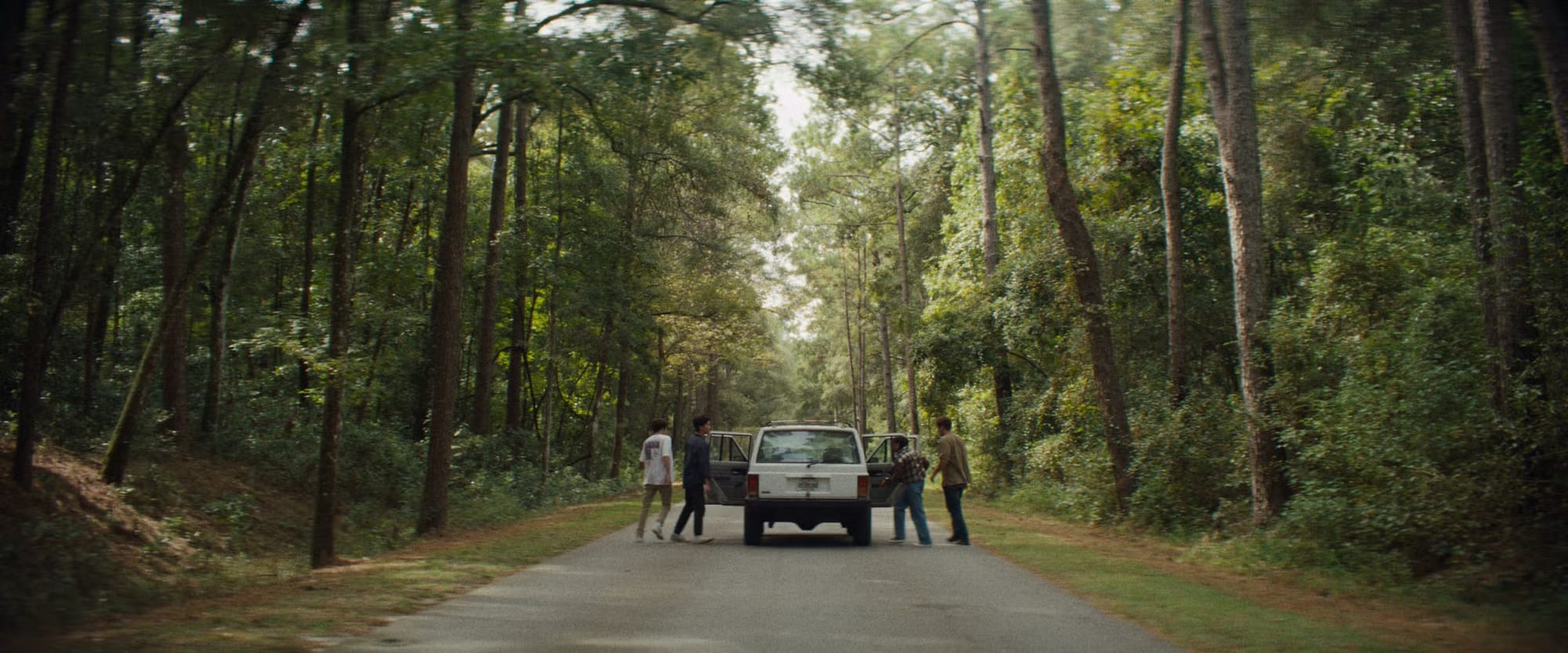
Recent graduates James, Day, and Fisher are either packing up a U-Haul to move away from college, or they just moved away from college and have arrived at their destination and will soon be unpacking a U-Haul. Either way, they are met outside an otherwise unidentified building by their friend Tyler, who they have not seen in a year, and who has "driven down" to help them (presumably) either move into the place, or out of it. He arrives as they are closing the back of the U-Haul, and so they all get in Tyler’s car to go… somewhere.
Later, it’s revealed that the group is going to get some food, making it extra unclear why they need GPS, as whichever inciting situation I mentioned above it is (it’s hard to tell), there's at least one person in the car who definitely currently lives in the area/city.
So... they're driving.
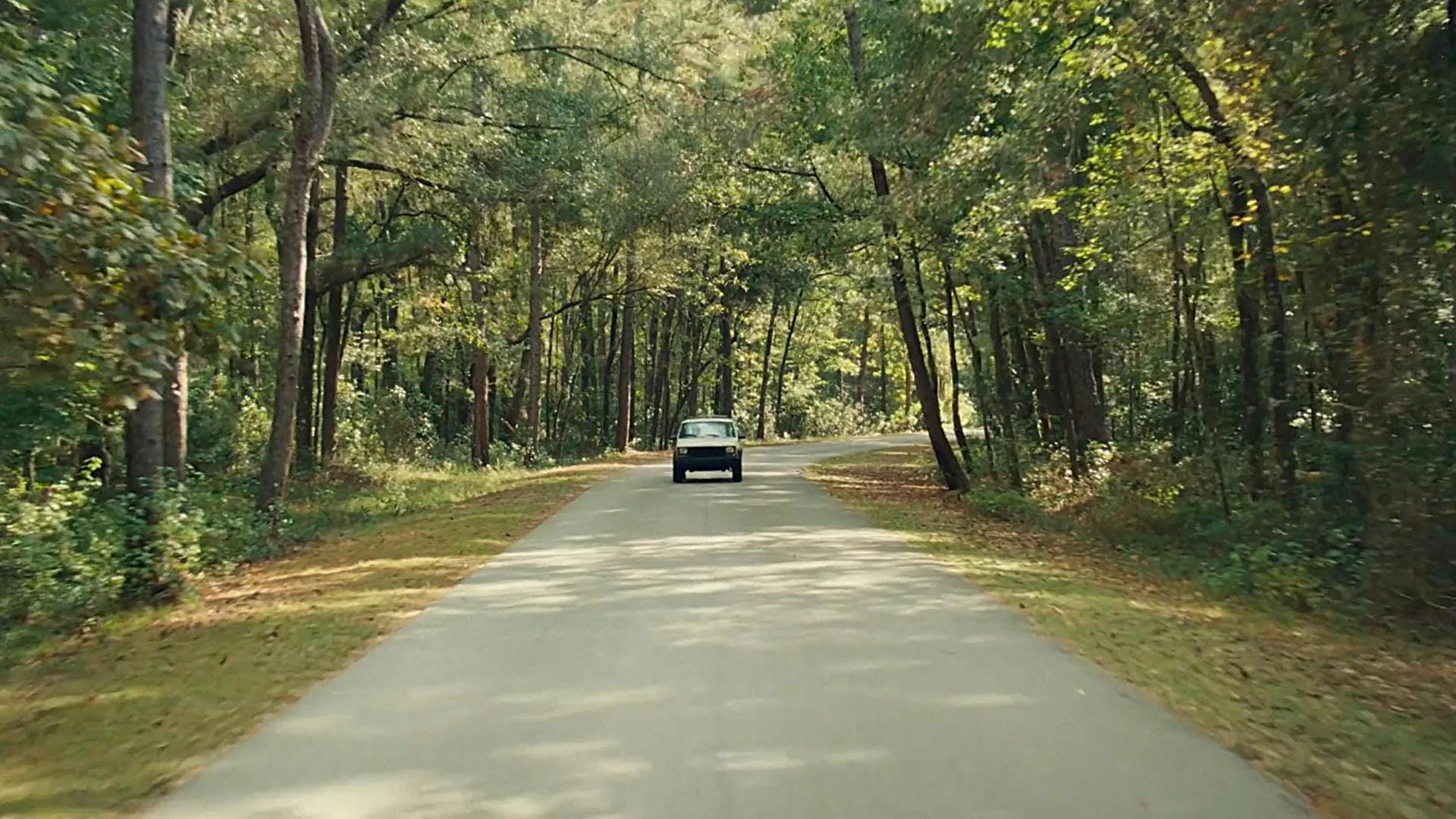
And then, as James and Fisher chatter away, entertaining themselves with the usual kind of inane internet debates of the “Caveman vs Astronaut” variety, while following Day’s GPS directions, Tyler turns down a forested road. Eventually, after a while, they all notice that they’ve been driving for a kind of long time, and that there's been no turn offs at all. The GPS says to keep going straight, but Tyler is feeling weirded out, and doesn’t like this idea, so he turns around. They drive back the way they came.
Only to find that the road eventually just ends, inexplicably blocked by a thick wall of trees.
As they stand there, confused, a horde of frantic young people emerge from the forest, swarm the car, clawing at them, and pleading for help. The four manage to drive away, but Fisher's arm is all cut up. A little ways away, they stop again, in order to tend to Fisher's wound, only for the car to be swarmed by another group of screaming and desperate young people. They drive off.
24 hours later, they’re still driving, and no one has eaten or pooped.
Also, the gas gauge hasn't changed. They don’t feel tired or hungry or horny either. Even though time is passing, as day has turned to night and then back to day; plus, Fisher’s arm is healing, the world around them is the same. The road just goes on, no signs, no turns, no breaks in the trees, it’s seemingly never-ending, and always the same too. Nothing but thick forest on both sides. They drive on, and begin to discuss the situation… are they dead? Did they crash? Is this purgatory, or maybe another dimension? What is happening? And why? For what purpose? Are they being punished? Why are they here? What is the goal? Will the road ever end? And what will they find there? They blame themselves, and they blame each other. They bicker and simper and confess secrets and even joke and laugh. The whole time, the road never changes. Also, they can’t stop, or they'll be swarmed by the people from the woods, all of whom seem to look and dress like our main characters, just average young people. But that doesn't really matter, as they're not tired or hungry or have to go to the bathroom, and the car is driving fine too, so they keep going.
But they decide to never turn off the engine, just in case.
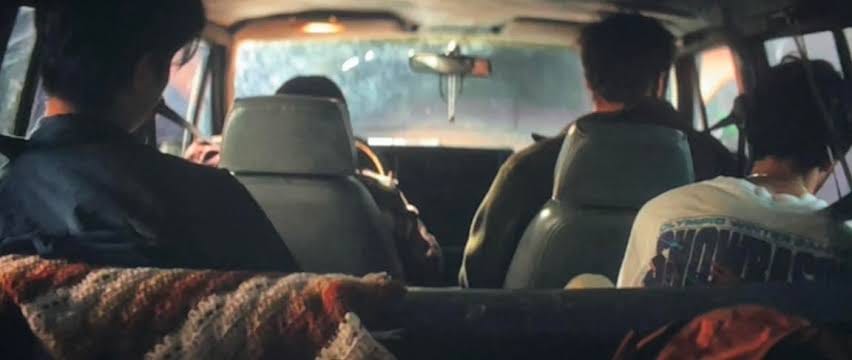
Focused on surviving, they inventory the car and discover that they have a single Clif bar, but seeing as none of them are hungry, they decide not to eat it, fearful of the potential consequences. They also stop the car and run a timer to see how long they get before the screaming people show up. It turns out to be 90 seconds. Using that 90 seconds, they try to explore the woods, and quickly stumble across people amongst the trees, quiet and docile and laying on their backs, staring blankly up at the sky. Until 90 seconds pass… then they freak out. They try to restrain one of the people in the forest, looking for answers, but the guy is zoned out, and he doesn’t answer, he doesn’t even seem to notice them, not until 90 seconds has passed, and then he starts screaming. At one point, they come across an abandoned car on the roadside. It's missing its keys, and its odometer is maxed out at 999,999 miles.
50,000-some miles later, Tyler gives up. He tells James that he has decided to stay in the forest. He is unwilling to get back into the car, and tells the rest of the group to go on without him.
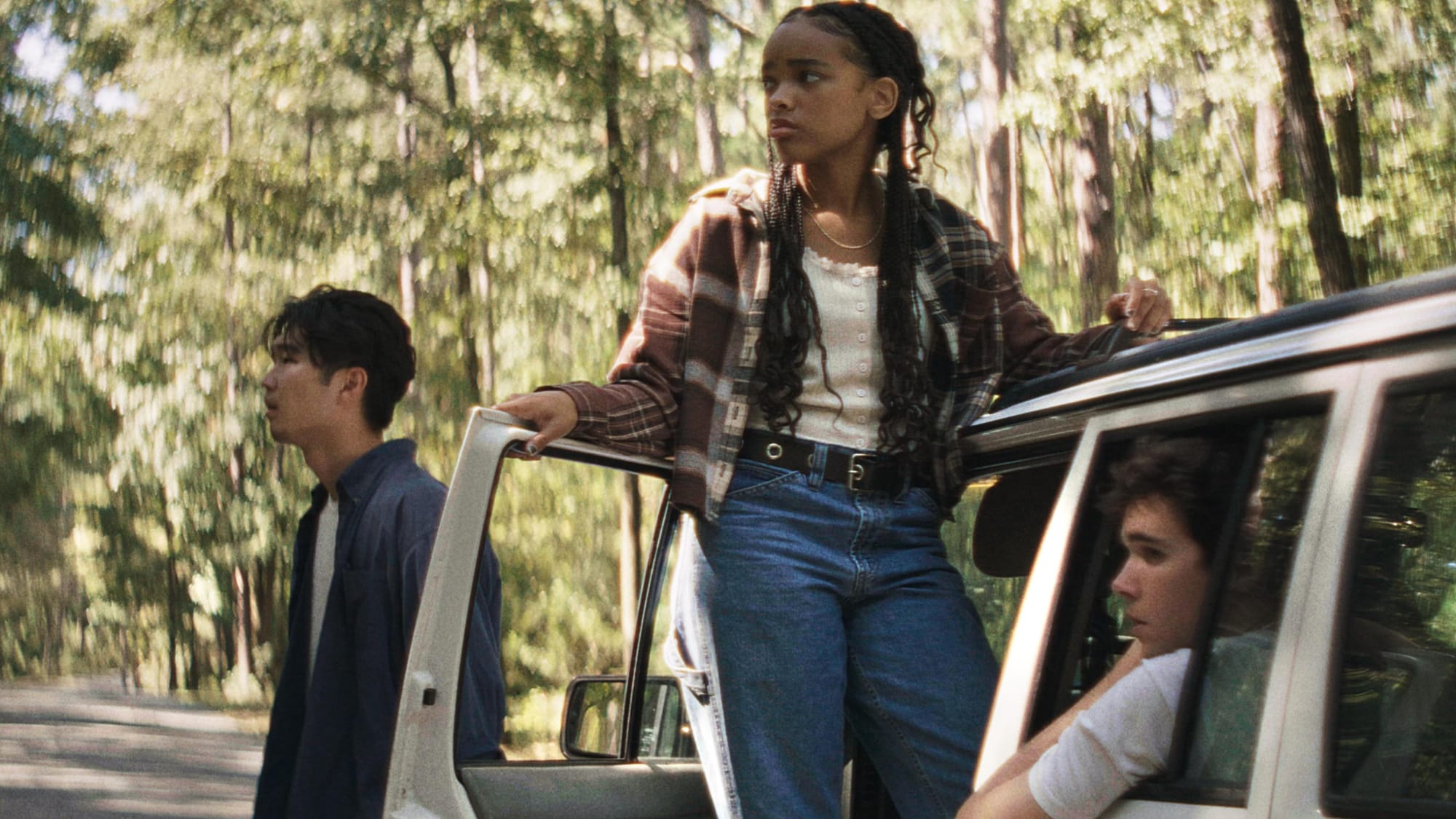
James, Day, and Fisher drive on.
A new routine takes hold. They loot the occasional abandoned vehicle. They idle and chat. They do little projects to amuse themselves. They settle into dealing with their strange situation in their own way. Day and Fisher have daily scream sessions at the side of the road. James declines to participate. The arguments start to seem a little more common, all rooted in the noticeable distance that’s growing between them, Fisher and Day on one side, James on the other. Then, another day, as well as many miles more down the road, while looting yet another abandoned car, they realize there are no screaming people rushing at them from the woods. They wait, but there's nothing. The screaming people are gone. They never see them again.
James is elated by this change, believing it has to mean something, perhaps it means they’re closer to the end, that they’ll finally beat the road, that they’ll reach the end, that they’ll win. Fisher and Day are less enthusiastic. In fact, Fisher and Day want to give up, after all this time, they want to try something new. They want to stop and walk into the woods.
And they want James to come with them.
In an incredibly selfish move, like the huge assholes that they are, Day and Fisher snatch the keys from the ignition, shutting the car off, and demand that James give up too. Fisher deserves the ass-kicking he gets from James, who gets the keys back, manages to get the car to start again, and drives off alone, leaving Fisher and Day behind together. He drives on, and on, and on, and on.
Finally, after over 1,100,000 miles, James has to stop…
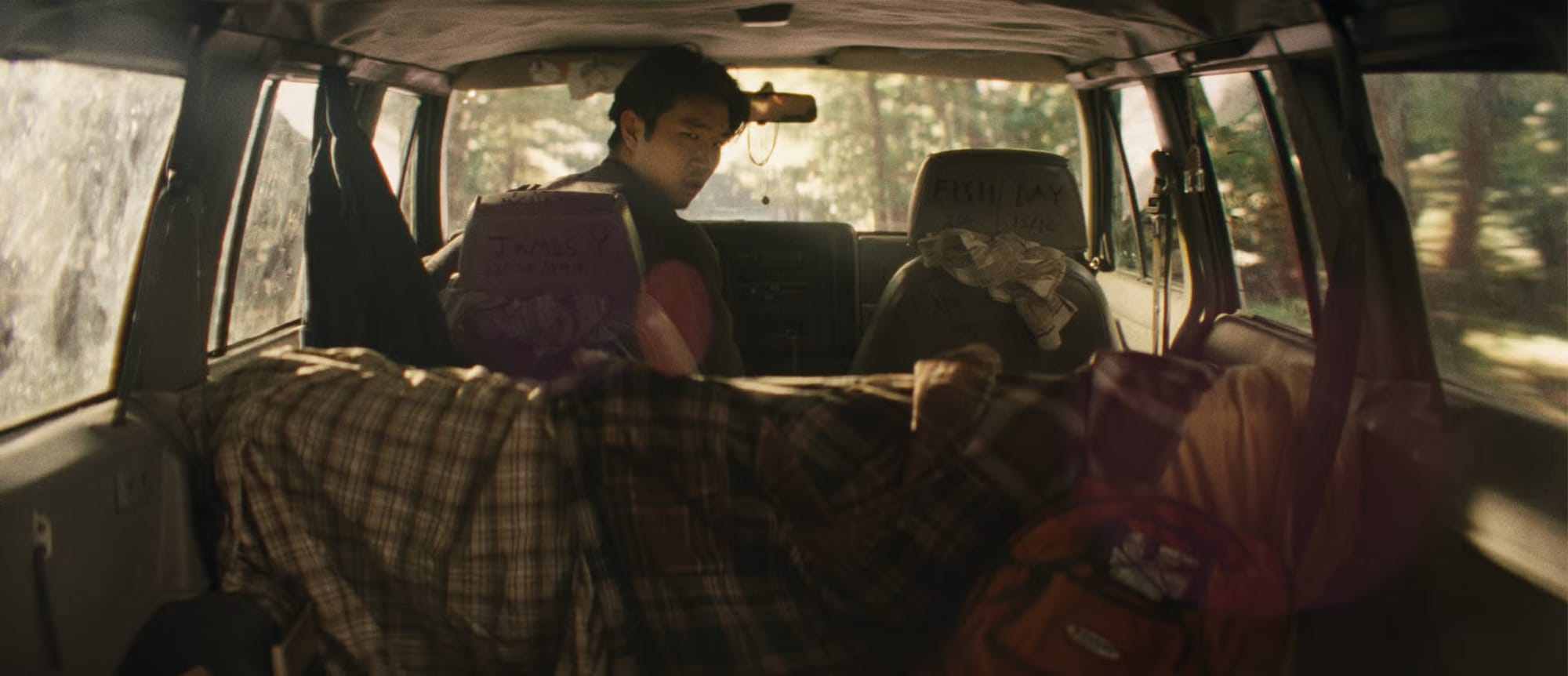
So, how does the film end? See title.
But that wasn’t my problem with this film. Not really. For me, my problem was rooted in the way the film started. It’s just a dumb little thing, sure, but it bothered me immediately, and I got more annoyed about it as the film went on, because this is my whole thing, people…
It didn’t have to be that way.
My problem with the beginning is that it's weirdly muddled nonsense, and clearly hand-waved away in order to get to the meat of the story. Who are these people? Where are they going? It's unclear, and it feels unnatural the way this context is missing from the set-up. The whole beginning set-up is a sour note the musicians rush past in the hope that you forget about it, which is an idea I understand. I do. Here's a problem that you can't fix, so just keep going. I get the idea. But that's my whole problem with the beginning... It's not that it's badly shot, or badly acted, or even badly written, it’s that it's poor storytelling. Needlessly poor storytelling.
Now, to be fair, the problem of who are these people is answered. Tyler was once the guy who could be counted on for a wild times, but that was clearly only because of his obviously long-ignored mental health problems—which seem to have caught up to him—and now he's a taciturn and fresh-out-of-the-Army veteran. Tyler also "drove down" to meet them, so he seems to live in the general area, but it’s implied that he lives a few hours away. Fisher’s a sensitive guy who seems like the type who bruises easily, literally and figuratively, but he’s a nice, sweet, and funny guy, if not a somewhat infantilized one. Through process of elimination, I believe that it is his stuff that's in the U-Haul. Day is the group's "little sister." She's a “Guys’ Girl” who is clearly struggling with who she is and who she’s supposed to be, worried that she will never find out what her “thing” is, and is consumed with quiet desperation for something to come along and fill that hole. This means that she and Fisher clearly like each other now, but just as clearly, they've never acted upon those feelings, as up until now, they’ve been “just friends.” Finally, James clearly has a lot of internal and external pressure on him to succeed, and because of this, he's already entered the job market, and the others razz him about that. He's also deeply self-conscious, so he always needs to be the smartest person in the group, even if it makes him the asshole. He also has an apartment. But is it local? Unclear, but from the way they rag on his decorating, Day and Fisher have at least seen it, but it also doesn't seem like he's the one that they're moving in, as it sounds like his problem is that he has stuff, but it's all bland and impersonal. So from the way they talk, it seems like he’s been living there for awhile now. Day, meanwhile, definitely lives in the area. From the way she talks about “going home” it implies that her place is close, as she talks about them "dropping her off" later. She’s also talks about her current job hunt in the resigned tone of a person who has been at it a while now, so to me, it seemed like she's been in her place for a bit too. So, as I said, from all this, it seems like Fisher is the one moving, and from their conversations, I think I'd lean toward what's going on is Fisher is moving back to an area they all grew up in, as he has recently graduated college. Now, I’m not sure if they left the U-Haul at Fisher’s new apartment (this is what it seemed like to me) or at the U-Haul lot (possible), but either way, Tyler has met them there, and they apparently decided to go get food, and... this is important (to me)... it's all happening in an area where at least one of them, without a doubt, currently lives, and potentially very likely, all of them had spent their childhood through their high school years living in.
So... why then do they need GPS?
They should know where they’re going, right? It really did seem like they were all old high school buddies and for the first time in a few years, they were all back in the place they grew up. And yet, no one in the car seems to have a clue where they are or where they’re going. How is that possible? How do they not know where they’re going? I don’t understand. They grew up there. At least one of them lives there now. And if they all just graduated college, or just finished their stint in the Army, then they’ve only NOT LIVED in this area for a few years. Why don’t they know where they're going? At least vaguely. I may not know where a restaurant is downtown off the top of my head, but I do know how to get to downtown or some other neighborhood in the city, because I live here. I certainly don't need GPS. And I would certainly recognize when I took a right turn from a world of street lights and other cars onto a suddenly pitch black rural back road...
I’m sure you’re probably now like, is this really that big of a deal, Jon?
Specifically, no, but a muddled storytelling fumble like this shouldn't happen. Fucking context clues, man! That's storytelling 101. You can't even tell that they're going to grab some food from the whole opening scene. They say it much later in the movie, that's how you know, otherwise, in the opening scene, there's no talk like “You guys will love this place” or “I’ve heard good things about this place” or “I can't wait to eat at this old favorite place again, it’s been years.” Nothing like that. As a result, I’ve seen other people say that the characters “accidentally” turned onto this road, when that clearly isn’t the case, as they‘re specifically following Day’s GPS to go… somewhere, I don't know where? It just doesn't make any sense why this film's opening scene is so unclear.
And the only answer is... the filmmakers failed. That's it. They couldn't figure out how to get these characters to the endless road, so they just rushed past the set-up, waving their hands about wildly, stuffing the scene with inane dialogue, hoping we wouldn't notice, but I did, and it bothered me.
Because this shouldn't be a problem.
Sure, sure, it’s a metaphor, I get that, but a metaphor forms over the course of a story. The story's beginning? That's what grounds you in its reality. The story of where these characters are going together, and why, is entangled with the story of who they are. The reason why the characters started their journey is important for determining where they end up. And simple fact, the filmmakers fucked that up. I mean, why not have them all be on a road-trip? A road-trip and a wrong turn?
I don't get it.
But I do get that it’s a magical road. It get that. That’s fine. I'm not looking for some big explanation for why the gas never runs out, or why they don't get tired or sleepy or hungry. I can guess the meta-reasons why they specifically include how they're not horny in that list too. The story behind the people in the woods is pretty obvious too. The metaphors here are... perhaps painfully... clear. The way back is blocked by trees because you can't go back to being a child, you can only go on and be an adult. The people in the woods are the ones who either won't admit this, or who are unable to start their own life, and need someone to tell them what to do next, and where to go. Tyler stays in the forest early on, because he killed himself over his unresolved mental health issues, which is why he's a Vet in the story, for the easy cliche. Day and Fisher decide they’re done at the same time because they are the friends who pair off, the ones who find a different kind of death, a far-away job, or maybe a distant suburb where they have kids and go to the mall and Chili’s and Starbucks and Chik-fil-A, or whatever. Either way, you never see them again. The uneaten Clif bar is the culture of fear that rules all of their lives, the terrifying belief that they can’t stop and enjoy themselves, that they can’t treat themselves, that there's a path they must follow, so they have to save all fun for later, for some day far out in the future, until eventually, all they're doing is planning for a future they never get to enjoy. But they do this, because if you do otherwise… something bad might happen. What if it harms you somehow? Your career could be over, and what if it turns out that it didn’t even taste good? What if the fun wasn’t worth it? Better to just work. Take that vacation next year. So yeah, I don’t need the film to give me any explanations of that, just like I don't need genre specifics explained to me either (although a little bit would have been nice, as that's part of the fun), because either way, I get it. It’s just a sinkhole in reality. A hellish pocket dimension or something. Twilight Zone shit. No problem. I get it.
But the question of who these characters are, where they come from, where they're going, and how they all got there? I do need that.
The story needs that.
I realize it looks like I'm over-thinking it here, that I'm too-focused on the specific ideas that weren't established, but this problem is a microcosm of the film's main problem. And that is that the filmmakers were clearly way too impressed with their rather easy and obvious metaphor, and as a result, they just don't tell a good story, not in a basic sense, or in a genre sense, and it kind of seems like they don't think that's an important part either, which doesn't bode well for future projects either.
Now, to be fair, this is just Gen Z updating Millenial mumblecore horror (sometimes known as mumble-gore), so it's not a surprise to find an emphasis on characters’ relationships, on naturalistic performances, and on improvised-feeling dialogue, with much less concern for plot. That's just kinda how mumblecore goes (and also why it kind of sucks...) but I understand, It Ends is just Hang-out Horror for the next generation. And while I’m loathe to link this to the more recent horror films like Backrooms and Obsession, because all they really have in common is they’re by young filmmkaers who posted on YouTube, it’s the horror du jour at the moment, so what're ya' gonna do? That said, I do feel like all of these films share a common problem of having some good ideas, some good direction, and some good performances, as well as some really good meat on their bones storywise, but ultimately they all have the same problem in that they don’t hold together.
It Ends' problem is the same as those two films, it has no idea how to end.
I appreciate that Ullom was attempting to say something personal here, as he describes the film as being about standing on the cusp of adulthood and the search for meaning that follows. That's great. And Gen Z definitely has some valid reasons to feel the crush of anxiety these days, being forced as they are to live in the faded, ugly ruins of the American empire, where every promise was a lie, nothing works, everything is broken, society is crumbling, and the only thing you can count on in your future is that at some point you’ll be dead. Plus, y'know... COVID and the rise of Trump, fascism, and white christian nationalism and all that truly awful garbage.
So that’s definitely heavy shit to deal with.
But because of that, some will say that this is a Gen Z movie, that you won't understand it unless you're Gen Z, but that's just fucking nonsense from children. The central idea of the film is simply that moment where we all discover the King of Champagne Problems in our way, which is that adult life is mostly just the same shit, day in, day out, occasionally punctuated by moments of excitement or fear, and hopefully some good times, and that this reality is worse than you were led to believe, certainly much worse than the sit-coms and influencers led you to believe, and so you're left to your own devices, forced to determine your own path, to forge your own structure and purpose if you want to survive the drudgery, sink or swim, but no matter what you do, you can't "win" and you won’t be rewarded for being a “good” person, and worst of all, none of it really matter either way once you’re gone, all of which is a fact that is really disappointing and depressing in and of itself, but it’s also just reality.
Every generation goes through this, usually about the same age too. It's "old hat" stuff. The simple fact that you're the one seeing this now for the first time doesn’t necessarily make the commentary deep. But that's why these characters are all an age where they're freshly post-final institution (both military and academic) as, up until that point, their lives have been mapped out, structured, and placed on a very set path. Can’t wait to be in high school. Can’t wait to drive. Can’t wait for college. Can’t wait to graduate. Once that's done, they discover that, from that point on, life doesn’t have any structure, it’s all gone, and you can’t go back either, it's blocked by trees. You can only go forward, with no way to win at anything, and no way to beat the system, just the same shit, different day, until you die.
Related tangent…
This is why it’s (usually white) above-average college educated people who join cults. You take a certain amount of classes, you get an orange sash. You take more advanced classes, then you get a brown one. At that point, you teach some classes, and that means you get a blue slash. Isn't the structure wonderful? So dependable and soothing. Eventually, after you teach enough classes, then you get a gold star on your blue sash… a gold star on your sash! And once you’re Starred, that’s when you get to be branded by Chloe Sullivan from Smallville, and once that heals, then she and Keith Raniere get to fuck you… Structure sure is nice, right? What a relief.
Anyway...
It Ends is just baby’s first existential crisis.
That’s not (totally) meant to be condescending, it just is what it is. It Ends is just the latest generation standing at the edge of the abyss and shouting in terror, “holy shit, it’s also gazing into me!” All the rest of us can really do is nod and shrug and say, “yeah, sucks, don’t it?”
Despite clearly having something to say, despite looking pretty good for a micro-budget film, despite showcasing generally good performances, the movie itself, the actual story, is unsatisfying. It Ends fails, not because it doesn’t communicate what it wants to say, but because it isn’t entertaining while doing it. Plus, if you want to say something important while wrapped in genre conventions, then you can’t just disregard the genre conventions completely. Jordan Peele does both, this film does not, and from what I've seen I’m not convinced that the filmmaker will ever be able to pull that off. In the end, It Ends is yet another in the recent spate of horror films with a pretty decent central idea, but that then fails make anything out of it, and all while being a little too light on the horror too.
After it ends, it's mostly just... fine.